Showing posts with label music. Show all posts

Friday, 18 January 2008

Francois Villon - Vagabond Poet

Murray Bookchin:
Francois Villon . . . The mediaeval poet was involved in an underworld, with its own parallel institutions - Princes, Counts - They were all crooks and in the City the legal world feared entering their quarters. Villon thrived there. He was a Murderer. He and his cohorts hung out in Brothels like Toulouse-Lautrec.

Janet Biehl:
So how did he get to be a poet?

Murray Bookchin:

He wrote wills that are works of art, comic, satirical, poetic . . .
He also wrote poems that ended with an envoi - "Lord of thieves, Be gentle to me." Wit was supremely important, Even as he faced the hangman.

Rest in Peace Francois Villon!
Rest in Peace Murray Bookchin!

Thursday, 13 December 2007

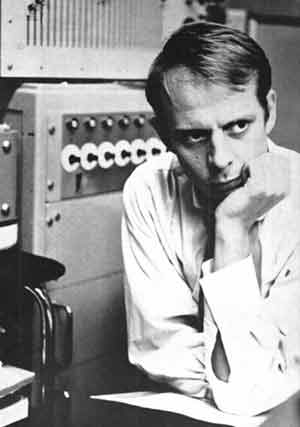
Comrade Stockhausen is Dead!

Lenin once described socialism as workers power and democracy + the electrification of the countryside. Karlheinz Stockhausen was a groundbreaking composer-philosopher of the 20th Century who used electricity to weave some of the most compelling and militant avant-garde sounds of the last 100 years and now the man is dead.

At one time, Stockhausen was named-checked by every Kraftwerk and Bjork listening pseudo-musical intellectual. For me, his electronic collages were the musical counterpart to TS Eliot's "The Wasteland" sketching out a landscape of modern distintergration that surrounded me.

Growing up in a council estate in a small market town meant that visionary and transcendental experience was sought outside of my own limited world of adolescence. Picking up a vox guitar and jacking it into an amplifier I would make weird sounds and try and reach out for something more in life. The screaming howl of feedback mirrored the scream of adolescent rage with a world gone wrong. An idealist I wanted genuine communion with the people and world around me, not experience mediated through some corporate product.

I discovered Stockhausen at around the same time as I hit upon one of his mentors, the brilliant Messaien. Messaien was a maverick French organ player who would construct huge gothic architecture in cathedrals around themes like the fire of Pentacost or the Ressurection of the dead . . . powerful stuff.

Like many young musicians I had my "secret heroes". Stockhausen was someone who taught me to be serious about the gaps in music, he had a concept of "coloured silence" that was incredibly useful. Another pioneer, Arvo Part once said, "that a single note played beautifully could me more important than a symphony" - I went on a quest to find that single note.

Stockhausen advocated a complete rejection of the entire canon of classical music. While such nihilism is ultimately futile and leads to a music that cannot connect to a mass audience it expanded the palate of many a musician and was another arrow in the quiver to use when times got tough.

Stockhausen's reasoning was poignant: He grew up in a world where Beethoven was what SS stormtroopers would listen to for relaxation after closing the oven doors on Jewish families. Classical music became the soundtrack for barbarism.

His father had been an enthusiastic National Socialist who went missing in the brutal war on the Eastern Front. His mother was one of many women forced into an asylum and fell victim to the Nazi's perverted science dying in their euthanasia programme.

Stockhausen described hearing the marching songs of war on the radio-set all through his childhood this scarred him with a lifelong hatred of repetitive, regular rhythms and pushed him out of the black and into the blue.

Whether Stockhausen was a political revolutionary is not important here. The militant socialist composer and one time musical collaborator, Cornelius Cardew, thought not and denounced him. What IS important was that Stockhausen was a musical revolutionary. Like the Kama Sutra his work is more of a manual or textbook than artwork in its own right.

Ultimately, Stockhausen's music was ugly. But as another musical prophet said, "The only beauty's Ugly, man". As a musician I'm still trading on the stamps that Stockhausen gave to me in my youth.

Goodbye, Comrade Stockhausen!

Monday, 12 March 2007

Music Without Borders . . . TONIGHT!


Not a Respect event, but a gig some Respect members were involved in setting up. Proceeds go to the Cardiff Campaign against Climate Change - a campaign we all need to support:
www.campaigncc.org

A unique collaboration between Palestinian and Welsh musicians:
MUSIC WITHOUT BORDERS
The Alternative Information tour

Monday 12 March at THE GATE Arts Centre Keppoch Street, off City Road, Roath, Cardiff Doors open at 8 pm Tickets: £4 (£3 concessions)

Tareq Rantisi and Mohamed Najem from Bethlehem join Gwilym Morus and Luke Evans from Bangor. A fusion of traditional Palestinian music with the traditional Welsh ballad form - canu penillion - in a contemporary context. In 2005, critically acclaimed Welsh musician Gwilym Morus visited Bethlehem where he wrote two songs with Palestinian musicians resulting in the release of the CD, From Bethlehem to Bangor. After a TV arts documentary on S4C and attention from many international DJs, the project now comes to Cardiff with a live gig that includes songs co-written via email over the past year.

Gwilym Morus:

"Musically our intentions are to fuse traditional Palestinian and traditional Welsh material in a contemporary context. The live performance will be a mixture of traditional instrumentation, such as the Arabic nye flute, daff and darbuka percussion, and elements of the Welsh canu penillion ballad form. This will be accompanied by guitar, banjo and digital sound produced live with a laptop. After the performance we will hold a short twenty min. question and answer session for the audience.

The collaboration works by exchanging ideas via mp3 on e-mail. The musicians consist of two from the Bethlehem area of Palestine, and two from the Bangor area of North Wales. This collaboration is a continuation of the project that began with the release of a four track CD earlier this year called From Bethlehem to Bangor.

Through this we hope to create a cultural relationship between one of the most comfortable countries in the world, and one of the poorest countries in the world, which continues to suffer in the horrific conflict that's consuming the region. We hope that this relationship can somehow promote a little understanding, compassion and respect between Western and Arabic people."

IN OUR WORLD THERE ARE BORDERS EVERYWHERE.
IN MUSIC THERE ARE NO BORDERS . . .