skip to main |
skip to sidebar
 WATCH THE NEW VIDEO DEDICATION TO CARDIFF COUNCIL HERE!
Following our correspondent's story yesterday highlighting the LibDem/Plaid Coalition nefarious plan to auction of our city's cultural treasures to the highest bidder on the sly, we have been bombarded with emails from concerned citizens. We will post up contact details for the Cardiff Heritage Friends campaign shortly.
Now bombard local politicians with letters demanding that our cultural heritage be saved. The more letters, emails, etc, that can be sent to the Council's Executive (and to your local ward councillors and your Assembly Member and MP), the better. One thing to request specifically is that the matter be put on the agenda of the next Council Executive meeting. Also the more letters to the press and postings on websites, the better!
The email address for Cllr Nigel Howells, the Executive Member for Sport , Leisure and Culture (and therefore the councillor responsible for libraries) is NHowells@cardiff.gov.uk
The report recommending the sale of the collections is published on the Council’s website. The report is entitled - we kid you not - ‘Disposal of Surplus [sic] Library Stock’. Cardiff Council have made Farenheit 451 a reality!


"A lot of people are aghast about this. For Cardiff, having these books is the difference between Cardiff being a local and Welsh interest library to being a library in the international league. In the past the council has not invested in these books and did not include them on the electronic catalogue, which means that the majority of people did not know they were there."
Dr Wyn James, Secretary of Cardiff Welsh Bibliographical Society, speaking to the BBC
One occasionally suspects that certain senior Council leaders have never read a book, this certainly might explain the wanton barbarism of the mafia who run the Council putting up our cultural treasures up for auction. This act of cultural vandalism from the LibDem/Plaid Coalition marks a new low point and a step back for the city.
Books that may be flogged off include Tyndale's Bible, one of the oldest English translations of the Bible, published in the 16th Century when translating the Bible into the common tongue was a deeply suversive and political act, risking death; Second edition Shakespeare's; Key English and European texts from the Protestant reformation; And a substantial and significant collection of political tracts from the English Civil War, an epoch of democratic struggle and revolution that our politicians may wish to forget, when the people deposed an autocratic and out of touch leader.
While certain books will be saved - including the 13th Century Llyfr Aneirin (The Book of Aneirin), the manuscript collection (including the Captain Scott manuscripts and Bute papers)., and early printed Welsh books and bibles, including a Bishop Morgan bible - Already over 100 books have been sent to the auctioneer with little evidence of public consultation, and talk of up to 18,000 antique books - many dating as far back to the 15th Century - to be flogged to the highest bidder.
Indeed, according to Peter Keelan, Head of special collections and archives at Cardiff University Library, the first batch of books date back to the 1500s and are probably the most valuable of the books being sold.
He identifies the key importance of this collection:
"There is nothing else here in Wales as the library in Aberystwyth concentrates more on Welsh texts. Students would have to go to London for their research. If these books disappear from Cardiff, research will grind to a halt."
Cardiff University has expressed an interest in taking custody the books to so that people from all over Cardiff could see them, and they would be available for scholars and research, but how could a university library match the sums that the Council will get from the auctioneers?
A new campaigning group, Cardiff Heritage Friends, has been launched as a coalition of local residents, historians, other academics, solicitors, and librarians, that is calling for the council to stop the sale "of some of Wales' greatest treasures".
This marks an escalation of the local council's attacks on public libraries and our cultural heritage. The council claims that it will use the sale from its cultural vandalism to fund public libraries, but should culture be funded by attacking culture?
When Cardiff Central Library was moved to its temporary home in a glorified shed, Council Leader, Rodney Berman made much spin of Cardiff soon having a 'state-of-the-art Library' but beneath the blather lies the reality that the new Central Library will contain much fewer books than the previous incarnation - what is this but a cut? Indeed, before the Library moved to its temporary home, hundreds of important books, many of them out-of-print and unavailable from bookshops were similarly sold off.
"Where there is no vision - the people perish". The Leaders of the Council have made it clear that they are not men and women of culture: The disgraceful threats to close one of Wales' finest music venues, the Point, the demise of the Coal Exchange, the hassle around the Toucan show this, the attempts to build a road through Bute Park. Or rather they have their own culture based around money and profit, expressed in Rodney Berman fighting hard to bring a Super-Casino to Cardiff, the St Davids Centre 2, and one of Wales' poorest areas - Loudon Square - being in an area that has had billions poured into 'regeneration' and surrounded by new luxury flats.
We hope to articulate an alternative vision of our city, and struggle to make Cardiff a city of culture and a city of the people.
 Her eyes are Palestinian
Her name is Palestinian
Her dress and sorrow Palestinian
Her kerchief, her feet and body Palestinian
Her words and silence Palestinian
Her voice Palestinian
Her birth and her death Palestinian
The LEFT Alternative in Cardiff salutes Mahmoud Darwish who died this week. Adam Johannes writes in tribute.
Mahmoud Darwish was not only the poet of Palestine, but one of the great poets of the twentieth century. It is perhaps fiting that he died aged 67 - the same age at which Edward Said, the great intellectual of national liberation, bid farewell to life, and in the same year as George Habash. All three men died in exile, and all three were iconic figures of Palestinian nationalism. They formed part of a generation of giants forged in the afterglow of the 1968 battle of Karemeh and birth of the PLO, and their lives spanned the great epic of modern Palestinian history that rose from the ashes of 1948 when the land disappeared from the maps of the world. Tragically none lived to see freedom and justice restored.
In Darwish's writing Palestine was not only Palestine, but also the loss of Eden, the fall of innocence, birth and resurrection, dispossesion and exile, love and rage. Stripped of his Israeli 'citizenship', a citizenship he famously derided in his poem 'Identity Card', he spent most of his life in exile, he was a witness to the '82 Israeli invasion of Lebanon when Beirut with all its flowers came to smell of smoke and fire. Beirut was to be a pivotal moment for him, his poetry and the dream of Palestine. He left on the raft of a ship with other members of the Resistance for Tunisia.
One commentator captured the greatness of Darwish: "under house arrest, having his second-class citizenship revoked, being chased and hounded from one exile to another, being bombed in almost each of these exiles and living under countless sieges, Darwish's humanism never succumbed. One of his most popular poems, Rita, spoke of his love for a Jewish Israeli woman by that name; and about the absurdity of wars coming between lovers. This poem was made into a popular song by Lebanese musician Marcel Khalife."
His deep humanism was witnessed in his address to the Israeli soldiers shelling his neighbourhood during the 2002 siege of Ramallah,
You, standing at the doorsteps, come in
And drink with us our Arabic coffee
For you may feel that you are human like us
Darwish will also be remembered for his hand in crafting the 1988 declaration of independence, and the speech with which Arafat electrified the UN General Assembly in 1974, "Today I have come bearing an olive branch and a freedom fighter's gun. Do not let the olive branch fall from my hand. Repeat, do not let the olive branch fall from my hand". He has the good sense to reject the the sell-out of the Oslo frauds.
Towards the end of his life, he became dismayed at the division in the Palestinian house. Last summer in a bitter voice thick with irony, he was to declaim:
"We have triumphed . . . Gaza won its independence from the West Bank. One people now have two states, two prisons who don't greet each other. We are victims dressed in executioners' clothing. We have triumphed knowing that it is the occupier who really won. We have to understand - not justify - what gives rise to this tragedy.
It's not because they're looking for beautiful virgins in heaven, as Orientalists portray it. Palestinian people are in love with life. If we give them hope - a political solution - they'll stop killing themselves.
Sarcasm helps me overcome the harshness of the reality we live, eases the pain of scars and makes people smile . . .the sarcasm is not only related to today’s reality but also to history. History laughs at both the victim and the aggressor.
I will continue to humanise even the enemy... The first teacher who taught me Hebrew was a Jew. The first love affair in my life was with a Jewish girl. The first judge who sent me to prison was a Jewish woman. So from the beginning, I didn't see Jews as devils or angels but as human beings." [Several poems of his poems were to Jewish lovers] "These poems take the side of love not war"
This poem written during the siege of Beirut, contains a line that poignantly captures the deadlock of the Palestinian resistance - "Where do we go after the last frontier? Where does the bird fly after the last sky?". After armed struggle, appeals to international law and the conscience of the world, negotiations, peace processes. mass civil disobedience, Palestine still remains unfree:
The earth is closing on us, pushing us through the last passage, and
we tear off our limbs to pass through.
The earth is squeezing us. I wish we were its wheat so we could die
and live again. I wish the earth was our mother
So she'd be kind to us. I wish we were pictures on the rocks for
our dreams to carry
As mirrors. We saw the faces of those to be killed by the last of us in
the last defense of the soul.
We cried over their children's feast. We saw the faces of those who'll
throw our children
Out of the windows of the last space. Our star will hang up in mirrors.
Where should we go after the last frontiers? Where should the birds
fly after the last sky?
Where should the plants sleep after the last breath of air? We will
write our names with scarlet steam.
We will cut off the head of the song to be finished by our flesh.
We will die here,
Here in the last passage. Here and here our blood
will plant its olive tree.
 Writing about the Black civil rights movement, Harlem Renaissance Poet-man, Langston Hughes scrawled:
What happens to a dream deferred?
Does it dry up
like a raisin in the sun?
Or fester like a sore--
And then run?
Does it stink like rotten meat?
Or crust and sugar over--
like a syrupy sweet?
Maybe it just sags
like a heavy load.
Or does it explode?
This year marks the 60th anniversary of the events that Palestinians refer to as Al-Nakba, 'The Catastrophe' when the land of Palestine disappeared from the maps of the world. Until there is justice for the people of Palestine there will be no peace in the Middle East.
If the American War of Independence (from Britain) was simultaneously a war of expansion against the indigenous native populative, then likewise what Israelis refer to as a "the war of independence" was also a war of expansion against the people who had lived there for generations. These people were ethnically cleansed and their memory cleansed also in an orgy of destruction that saw over 400 Palestinian villages totally destroyed in the land that is now called Israel.
Like the Native Americans, Palestinians were driven at gunpoint from the land where they had lived for generations, many were herded into refugee camps where they still live alongside children and grandchildren. The West Bank, Gaza and East Jerusalem was carved up between the Arab states, and later under Israeli occupation. A small remnant remained in Israel to live as third-class citizens. For the first twenty years of Israel's existence this Palestinian minority lived under direct military rule. The situation in the Middle East is explosive, 60 years of dispossession is 60 years too long: Palestine is a dream deferred.
 Who built the seven gates of Thebes?
The books are filled with names of kings.
Was it the kings who hauled the craggy blocks of stone?
And Babylon, so many times destroyed.
Who built the city up each time? In which of Lima's houses,
That city glittering with gold, lived those who built it?
In the evening when the Chinese wall was finished
Where did the masons go? Imperial Rome
Is full of arcs of triumph. Who reared them up? Over whom
Did the Caesars triumph? Byzantium lives in song.
Were all her dwellings palaces? And even in Atlantis of the legend
The night the seas rushed in,
The drowning men still bellowed for their slaves.
Young Alexander conquered India.
He alone?
Caesar beat the Gauls.
Was there not even a cook in his army?
Phillip of Spain wept as his fleet
was sunk and destroyed. Were there no other tears?
Frederick the Greek triumphed in the Seven Years War.
Who triumphed with him?
Each page a victory
At whose expense the victory ball?
Every ten years a great man,
Who paid the piper?
So many particulars.
So many questions.
- Bertold Brecht
 Murray Bookchin:
Francois Villon . . . The mediaeval poet was involved in an underworld, with its own parallel institutions - Princes, Counts - They were all crooks and in the City the legal world feared entering their quarters. Villon thrived there. He was a Murderer. He and his cohorts hung out in Brothels like Toulouse-Lautrec.
Janet Biehl:
So how did he get to be a poet?
Murray Bookchin: He wrote wills that are works of art, comic, satirical, poetic . . .
He also wrote poems that ended with an envoi - "Lord of thieves, Be gentle to me." Wit was supremely important, Even as he faced the hangman.
Rest in Peace Francois Villon!
Rest in Peace Murray Bookchin!
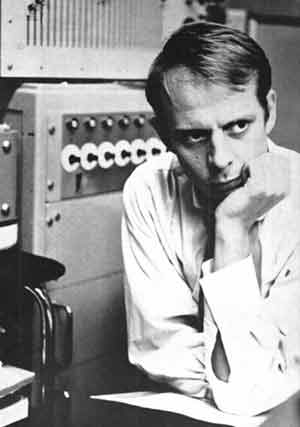
 Lenin once described socialism as workers power and democracy + the electrification of the countryside. Karlheinz Stockhausen was a groundbreaking composer-philosopher of the 20th Century who used electricity to weave some of the most compelling and militant avant-garde sounds of the last 100 years and now the man is dead.
At one time, Stockhausen was named-checked by every Kraftwerk and Bjork listening pseudo-musical intellectual. For me, his electronic collages were the musical counterpart to TS Eliot's "The Wasteland" sketching out a landscape of modern distintergration that surrounded me.
Growing up in a council estate in a small market town meant that visionary and transcendental experience was sought outside of my own limited world of adolescence. Picking up a vox guitar and jacking it into an amplifier I would make weird sounds and try and reach out for something more in life. The screaming howl of feedback mirrored the scream of adolescent rage with a world gone wrong. An idealist I wanted genuine communion with the people and world around me, not experience mediated through some corporate product.
I discovered Stockhausen at around the same time as I hit upon one of his mentors, the brilliant Messaien. Messaien was a maverick French organ player who would construct huge gothic architecture in cathedrals around themes like the fire of Pentacost or the Ressurection of the dead . . . powerful stuff.
Like many young musicians I had my "secret heroes". Stockhausen was someone who taught me to be serious about the gaps in music, he had a concept of "coloured silence" that was incredibly useful. Another pioneer, Arvo Part once said, "that a single note played beautifully could me more important than a symphony" - I went on a quest to find that single note.
Stockhausen advocated a complete rejection of the entire canon of classical music. While such nihilism is ultimately futile and leads to a music that cannot connect to a mass audience it expanded the palate of many a musician and was another arrow in the quiver to use when times got tough.
Stockhausen's reasoning was poignant: He grew up in a world where Beethoven was what SS stormtroopers would listen to for relaxation after closing the oven doors on Jewish families. Classical music became the soundtrack for barbarism.
His father had been an enthusiastic National Socialist who went missing in the brutal war on the Eastern Front. His mother was one of many women forced into an asylum and fell victim to the Nazi's perverted science dying in their euthanasia programme.
Stockhausen described hearing the marching songs of war on the radio-set all through his childhood this scarred him with a lifelong hatred of repetitive, regular rhythms and pushed him out of the black and into the blue.
Whether Stockhausen was a political revolutionary is not important here. The militant socialist composer and one time musical collaborator, Cornelius Cardew, thought not and denounced him. What IS important was that Stockhausen was a musical revolutionary. Like the Kama Sutra his work is more of a manual or textbook than artwork in its own right.
Ultimately, Stockhausen's music was ugly. But as another musical prophet said, "The only beauty's Ugly, man". As a musician I'm still trading on the stamps that Stockhausen gave to me in my youth.
Goodbye, Comrade Stockhausen!
 KNOW THY ENEMYChristopher LogueKnow thy enemy:he does not care what colour you areprovided you work for him and yet you do!he does not care how much you earnprovided you earn more for himand yet you do!he does not care who lives in the room at the topprovided he owns the building and yet you strive!he will let you write against himprovided you do not act against him and yet you write!he sings the praises of humanitybut knows machines cost more than men.Bargain with him, he laughs, and beats you at it;challenge him, and he kills.Sooner than loose the things he ownshe will destroy the world.SMASH CAPITAL NOW! But as you hasten to be free And build your commonwealth Do not forget the enemy Who lies within yourself.