Showing posts with label socialism. Show all posts

Saturday, 6 September 2008

Welsh History Day School - A Report

A report of the recent day school on Robert Owen & The Co-operative Movement, hosted by the Welsh People's History Society, Llafur by Anna Guevara from the LEFT Alternative.

With an early autumn monsoon and swathes of South Wales flooded, we were fearful that the day school on "Robert Owen and the Co-operative Movement", might be rained off, especially with the venue – Pontypridd Museum – being perilously close to a river . . .

Fortunately, the event went ahead as planned, and around 40 people’s remembrancers crammed into a basement hall to hear a series of papers and presentations on 150 years of the co-operative movement in Wales from the Chartists to Tower Colliery. The day school was opened with two enjoyable and stimulating papers by Bryan Davies of Pontypridd Museum, and Llafur stalwart, Alun Burge, both demolishing the generally held belief that the first co-operative in Wales was at Cwmbach – We were to learn that morning, that the Cwmbach co-op was neither the first, nor the second, third, fourth or fifth co-operative in Wales. We discovered that neither were the Rochdale Pioneers the first co-operative in Britain. Instead we heard a fascinating story of how working class rebels linked with the Chartist movement launched the first co-ops because town-shopkeepers were hostile to their politics. This forgotten history of Chartist Co-operatives was one that Llafur promised to do more future research on.

The story of the first co-operative in Wales at Pontypridd is to be found in the pages of the Northern Star, the radical newspaper that played the role of organiser in the Chartist movement. We heard of a co-operative that could not get groceries from local wholesalers who refused to sell to the radicals, and enquired for information on wholesalers further afield. The co-operative was also subject to attempts at sabotage from the local tradespeople and town councillors. The Chartists linked with the co-op met in a local beer-house, ostensibly for Welsh lessons, but the police expected more subversive purposes – though historical information is scarce due to the insurgents taking the traditional collective oath of secrecy.

What was especially inspiring was how these early co-operatives were closely interlinked with the beginnings of militant trade unionism and political agitation, and essentially formed self-help organisations set up by the most politically conscious workers at the time. Historians argue that the Pontypridd co-op failed because it went bankrupt through extending too much credit to striking train workers at Brown-Lennox, a similar story was told about the Cwmbach co-op, that it went out of business through overfunding the 1921 miners lockout, indeed, the co-op effectively funded the lockout.

A key figure in the Pontypridd Co-op was a radical Doctor and Chartist leader named William Price, A whole book could be written about Price (and probably has!), an early pioneer of cremation who played a role in laying the ground for the final legalisation of the practice in 1902, he was also a druid and an advocate of free love.

Dr Price can also be seen as a father of socialised medicine: Elected doctor by striking workers who paid weekly contributions in return for free health care, he caustically commented that people paid for doctors when they were sick, but that people should only pay for doctors when they had been cured, and when they were sick the doctors should pay the patients!

An interesting angle was opened up, when we heard about the influence of Iolo Morganwg, stonemason and inventor of the modern bards, on Price and Welsh chartists. It was argued that Morganwg bequeathed Welsh radicals the equivalent of the English concept of “the Norman Yoke” (read Christopher Hill for background on this idea). The Welsh couldn’t look back to a golden age before the Norman conquest of justice because they had never been conquered by the Normans!

Iolo, “The bard of liberty”, invented a fiction of a radical and democratic druidic past long before the Roman invasion of Britain, a distant Welsh or British utopia, presided over by Druids who were lawgivers and moral teachers, a fiction was promoted that in the Middle Ages, Welsh Kings were appointed and removed by popular assembly. William Price believed that this utopian past could fire people's imaginations to create a radical present.

We heard anecdotes that Iolo's Triads of the Social State had even influenced Karl Marx, and it was argued that Iolo had shaped many false ideas that people had of medieval Welsh history, speakers argued that people had read the Laws of Hywel Dda through the prism of Iolo’s preface that gave them a democratic and egalitarian twist that wasn’t really there: For example a group of 19th century squatters invoked in their defence the laws of Hywel Dda, but it was claimed that they had inherited a false and romantic idea of the laws.

This inspired much controversy with the floor, especially when the speaker raised the issue of Welsh suffragettes claiming inspiration from Celtic women who supposedly enjoyed equality as an example of how a completely romanticised view of the laws had developed. Some argued that Hywel Dda’s laws were progressive particularly in regards to divorce and defended them as an egalitarian system of law.

Other presentations were concerned with Robert Owen, needs no introduction from us, except to say that the verdict is still open on whether he was a utopian socialist or an enlightened capitalist. Certainly he was a pioneer of adult education and nursery education, and defender of childrens rights, and pioneered reforms such as sick pay, but my own gut feeling is that he belongs to the prehistory of the working class movement.

The conference ended with a discussion of the relevance of co-operative movement today. A paper promoting co-operative schools stimulated discussion, while one speaker from the floor bitterly commented that some co-ops treated their workers just as shoddily as capitalist firms. Others saw the co-operative as offering a model for self-help and decentralised alternative to top-down socialism. While a few implied that Owenites were middle class do-gooders and paternalistic. Another debate hinged on ‘nationalisation’ and the nature of public ownership. People argued that their needed to be some grassroots form of public ownership based on democratic and community control, leading to a general debate on what socialism should be in Century 21.

Llafur is to be commended on organising an enjoyable and educational conference. The next event will be a day school History of Welsh Sport at the SWALEC Stadium, Cardiff on the 1st November. The event is free. Contact Siân Williams s.f.williams@swansea.ac.uk to book your place. Another day school on gender and sport will take place in Cardiff in November.

Wednesday, 8 August 2007

Why Are Disabled People Oppressed?

Capitalist ideology views disabled people as “surplus to requirements”. We need to fight for a society that meets people’s needs rather than excluding them, writes Pat Stack from RESPECT

It’s important for socialists to understand the nature of the oppression that disabled people face. There is no question that disabled people are oppressed – but our oppression has somewhat different roots to that of women or ethnic minorities.

Disabled people face discrimination every day in terms of negative attitudes and exclusion from wider society. But in the past we have faced much more extreme forms of repression.

In Germany during the 1930s, the first victims of the Nazis were 100,000 disabled people – or “inferiors”, as they were called. People with physical and learning disabilities were butchered as a consequence of Hitler’s ideology of “racial purity”.

Their bodies didn’t fit, so he got rid of them – before moving on to the Jews, Gypsies, trade unionists and so on.

So the oppression of disabled people, either historically or today, is no less than that of other oppressed groups in society such as women or black people. But it doesn’t quite serve the same purpose – discrimination against disabled people arises from a slightly different economic motive.

Under capitalism, women are seen as a source of cheap labour (especially with regards to childcare) and a source for the reproduction of labour.

That is why capitalism has an interest in the continued oppression of women. It also has an interest in promoting racism as a means of weakening and dividing the working class, thereby driving down the costs of labour.

Profitability

For disabled people, the root of our oppression is the fact that capitalism sees everything in terms of profit and profitability – and this colours how capitalists view disabled workers.


Most employers see disabled employees as a “problem” – something difficult, something different, something that will cost them more to employ. That isn’t to say that capitalists are incapable of realising that disabled people can be a source of cheap labour.

But the oppression starts from a different trajectory – the initial assumption is that disabled people are worthless under capitalism, rather than of great use within capitalism.

So the oppression of disabled people is a reflection of the way in which capitalism reduces everything to profit – effectively, capitalism says disabled people are surplus to requirements. This is especially true in periods of economic crisis – provision for disabled people is always one of the first things to be hit.

It’s important that we understand the roots of disabled people’s oppression, since that understanding also gives us clarity with regards to what we’re fighting against – and why we’re fighting against it.

The starting point for the disability movement is that you don’t deny that impairments exist, that people have impairments. But the impairment, in and of itself, does not deny people access to employment, social integration, general wellbeing and so on. Those things are denied because society denies them.

They are denied when society fails to provide the means to overcome that exclusion, when it fails to provide access and employment to disabled people, when it chooses to segregate disabled people unnecessarily.

That is the starting point – what we call the social model of disability. And despite the huge steps forward in terms of awareness of these issues, much exclusion still exists.

Moreover, much disability exists because of the kind of society we live in. Large numbers of people across the world are disabled because of the poverty they live in – because of undernourishment, environmental pollution, a lack health and safety provision at their place of work, or because of the carelessness of capitalism.

Unemployed

Discrimination in the job market is a fact of life for people with disabilities. If you’re disabled, you’re three times more likely to be unemployed and six times more likely to be turned down after submitting a job application than if you’re not disabled.

If you say you are disabled on your job application form, you are six times more likely not to be interviewed.

If you get an interview, you are six times more likely to be rejected for the job. And if we look at the question of wages, most disabled people are forced into poorly paid, low skilled jobs. That’s the reality of life for disabled people in the job market.

One approach to dealing with this discrimination is that of organisations such as Remploy – government aided factories that employ people with disabilities. These government workshops are by and large something that’s been fading out in recent years. Remploy in particular has been in the news because its factories are facing closure.

Traditionally what Remploy represented was the segregation of disabled workers – which is why large numbers of disability activists have long objected to the way Remploy is run.

Now Remploy workers are fighting to defend their jobs – but many disability charities have lined up with the government to say the factories should be closed.
While Remploy is something that socialists would want to see consigned to the past, the way to go about that is not by picking people off and forcibly throwing them into a job market that is hostile to them. We should fight for a job market where there is no longer any need for specialised workplaces to employ disabled workers.

The majority of disabled people earn lower wages, while living costs are frequently higher for disabled people. So it’s not surprising that something like two thirds of disabled people live below the poverty line.

Historically the notion was that if a person was disabled, and if nobody could look after them, then they should be put into an institution of some sort. Nowadays the emphasis is on making sure that appropriate care can be provided at home – which is a real advance in terms of society’s attitudes to disabled people.

More recently there have been further advances that question who controls that home care – the disabled person or the care agency.

If you’re a disabled person there is no reason why you shouldn’t prefer going to bed at 11pm rather than at 8pm because that suits somebody else. Your life shouldn’t be lived as if you are in a hospital the whole time.

These changes are real, but there are problems. There is much fine talk from the government about liberating the care environment, giving disabled people real freedom and choice and so on. But in reality you often find the exact opposite is happening. The problem is that the funding is not there, especially at local authority level.

I work for a disability charity. We have people who ask us for more care and more support.

They’ll say, “I’m on my own – I need somebody to come in at night because I need to go to the toilet at night. So I need somebody to come in for a couple of hours.”
Humiliated

The response to these requests is increasingly becoming either (a) “Don’t drink water before you go to sleep,” or (b) “We’ll provide you with incontinence pants.”
So either you’re totally humiliated or you’re lying there thirsty. The government talks about providing “liberation” but won’t provide the funds so that disabled people can make real choices.

In Camden, north London, where I live, there had been no charge for disabled home care – but this has changed recently. Anyone who has more than £30,000 in savings gets charged, as does anybody who receives disability living allowance.

So take a person whose sole income is income support and disability living allowance. Now local authorities are saying we want a big chunk of that disability living allowance back off you in order for us to provide you with care. You are effectively paying a disability tax.

I met the Tory councillor who introduced this change and he said, “This is New Labour policy – we’re just doing what the government says we should do.” Not many people realise you now basically have to pay for the “privilege” of being disabled.

We have to understand what is happening – and we have to understand that fighting for the rights of disabled people means fighting for a different kind of society, one where people’s needs are the priority rather than profits.

Thursday, 19 July 2007

It's never too late to love - or rebel!

Culture is an important weapon in the struggle for socialism: Socialism is an important weapon in the struggle for culture . . .

"When I was growing up in Pakistan at age 16 or so, I would go to a poetry reading that would start after dinner about 10:30 p.m. and it would be going on when it was time for breakfast. In the morning we were just swaying with the rhythm of the words and the chant would go up from the crowd to recite some extemporary poetry–make it up. The poets would then have a competition. They would decide on a subject and recite poetry. And the audience would judge which one was the best." - Tariq Ali

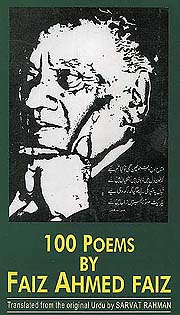
Faiz Ahmad Faiz was a revolutionary, an anti-imperialist and one of the greatest poets to ever walk the earth. He is considered by some to be the national poet of Pakistan and many of his poems have become popular songs. This perhaps his most famous poem begins with a beautiful description of a love affair and infatuation, but the idyll is suddenly interrupted by injustice in the world and the poet declares that he must renounce the cocooon of romantic love for something else.

DON'T ASK ME FOR THAT LOVE AGAIN
Faiz Ahmad Faiz

That which then was ours, my love,
don’t ask me for that love again.

The world then was gold, burnished with light –
and only because of you. That’s what I had believed.
How could one weep for sorrows other than yours?
How could one have any sorrow but the one you gave?
So what were these protests, these rumors of injustice?
A glimpse of your face was evidence of springtime.
The sky, wherever I looked, was nothing but your eyes.
If You’d fall into my arms, Fate would be helpless.

All this I’d thought, all this I’d believed.
But there were other sorrows, comforts other than love.
The rich had cast their spell on history:
dark centuries had been embroidered on brocades and silks.
Bitter threads began to unravel before me
as I went into alleys and in open market
ssaw bodies plastered with ash, bathed in blood.
I saw them sold and bought, again and again.
This too deserves attention. I can’t help but look back
when I return from those alleys –what should one do?
And you still are so ravishing –what should I do?
There are other sorrows in this world,
comforts other than love.

Don’t ask me, my love, for that love again.