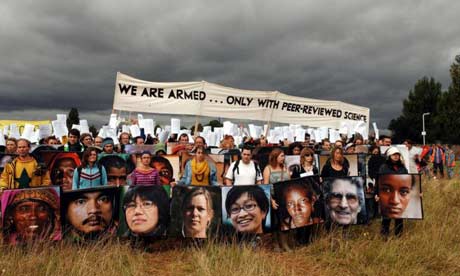
Showing posts with label ecology. Show all posts

Wednesday, 15 October 2008

Are YOU Green?

The LEFT Alternative received this message in our big Cardiff postbag:

"Cardiff hasn’t had a Greendrinks…until now! The first Cardiff Greendrinks will take place at The Yard, St Mary’s Street tonight onWednesday, October 15th at 6pm. This is our first meeting so we are finding our feet and we want to find out what people want from Greendrinks Cardiff, and when and where they want it before a grand launch in November. In the spirit of Greendrinks we couldn’t think of a better way to do this than to invite people along and ask! Please pass on these details to anybody you think may be interested, and of course bring along any friends and colleagues.
Can’t make it but want to in future? Want to help organise Greendrinks? Want to get your group involved with Greendrinks? Please let us know at alun.nicola@virgin.net or drop us a message."

For those who don't know Greendrinks is a laid back monthly meeting where people with an interest in all things environmental and green can relax and talk over a . . . drink! It's an international movement. To find us, turn up and say, "Are you Green?" (Though the LEFT Alternative bloc at the bar will also answer to the greeting, "Are you Red?". For us, our socialism and our ecology go hand-in-hand)

Wednesday, 8 October 2008

Defend Holtsfield

Once again Holtsfield Community on the Gower Peninsula is under threat with an attempted eviction on Tuesday. Adam Johannes, from the Left Alternative (Roath Branch) reports.

A couple of years back, I had the great honour to visit Holtsfield as part of a day of cob-building. Cob-houses are a form of sustainable housing made from clay bricks. The clay means that the house is warm in winter meaning no need for heating, thus cutting down on energy bills, and lovely and cool in the summer. During my visit I also saw an organic farm and straw bale houses. But the jewel in the crown of Holtsfield is its low impact housing.

In secluded semi-woodland you will find a random settlement of almost thirty single storey chalets. Holtsfield is part of the heritage of South Wales. Originally holiday homes, the chalets were occupied by working class people who had their homes bombed during the war. The chalets are beautiful, and highly individual painted in different colours and made of timber and lightweight materials. Visitors always comment how they seem to melt into the landscape.

Since the hard times of the post-war period the community has developed a village like ambience and is home to people from many different walks of life and background.

Around 1990 things changed when, the freehold was bought by a Swansea development company, Elitestone Ltd. This has resulted in a longterm struggle by the company to evict the residents, harrass them and plans to move in rich people and build houses. The company also lobbied to overturn the designation of the area as a conservation area. Now they are planning to carry out evictions. We urge everybody who can make it to get down to Holtsfield.

Bonita James reports:

"On the Tuesday 14 October at half past 12 there is a planned eviction of number 9 Holtsfield.This is my mothers house and the house I grew up in.

Show your support and if you are able to turn up on the day to peacefully protest, your help would be much appreciated. We do not wish for any violent behaviour at all, we mainly want witnesses because last time the behaviour of the hired security was very heavy handed so the more people there to see it, the less likely it is someone will get hurt.The last time Tim Jones tried to evict was in 1998 and it was only avoided due to local community support on the day. As so much time has passed since then a lot of people are unaware that the threat of eviction is still present. All this group hopes to achieve is to gather support and inform people of the current circumstances."

Thursday, 18 September 2008

Protest against Proposed Motorway through the Gwent Levels

Protest against the proposed motorway through the Gwent levels.
No New M4! - The Big CALM Protest
Tuesday 23rd September at 12 Noon
Steps of the Senedd, Cardiff Bay


The day after the Assembly re-opens after the summer break; CALM will be holding a protest on the steps of the Senedd.

This is our chance to tell the government that enough is enough, and that these damaging plans need to be axed, now.

This is your chance to tell your elected representatives that you don't want your money spent on destroying our natural heritage and the atmosphere. Join us in opposing this environmentally devastating scheme! Please pledge to attend our protest event.

For those who do not know about CALM, it stands for Campaign Against the Levels Motorway which will cut through 5 miles of the Gwent Levels SSSI, in reens, destroying grazing marsh, affecting the habitat of species like otter, water vole and barn owl (and being certain to cause road deaths of far too many otters and barn owls too), turning three chunks of the Gwent Levels into pathetic isolated 'islands' cut-off from the remainder of the Caldicot and Wentlooge Levels, with pollution from the scheme set to spread through the reen system to damage the freshwater life of the whole wetland system.

www.savethelevels.org.uk

Tuesday, 2 September 2008

SAVE BUTE PARK!

The LEFT Alternative has just received this tip off from a very concerned citizen (see below), a response from Cardiff Councillor Nigel Howells whose brief is Sports, Leisure & Culture to these concerns can be found in the comments section to this article.

"Cardiff Council has brought back plans to put a new access bridge into Bute Park and a ROAD through the park - this is immediately opposite the end of Corbett Road (ie off North Road and opposite Optometry).

In fact these are plans that will change the face of the park as we know it - the bridge is to be 9 metres wide! - this is to let 2 articulated lorries pass each other - a new, very wide road then drops over the feeder canal and down into the park near the nursery.

Many trees will be removed - amazingly a large number have already been removed without any planning permission approved - you can see the gash in the tree line. The plans have to be abandoned before the election but they are BACK with them again!"


Sign the petition here

Our correspondent asks:

"Have you seen the destruction, on the pretence of taking down a diseased tree! I hope you are appalled. Are the Council officers covering up this unlawful action BEFORE planning permission?"

Bute Park's designer and planer, Andrew Pettigrew, was one of the most important park designers of the second half of the nineteenth century, andthe open, flowing informal design allowed a smooth transition from a private pleasure ground to a public park. Much of the Victorian planting, particularly of ornamental trees, survives but are the trees safe in Cardiff Councils hands?

PLEASE OBJECT TO:

e-mail: rcole@cardiff.gov.uk

internet: www.cardiff.gov.uk/dc


Development Control, Strategic Planning & Environment, Room 127 City Hall, Cardiff, CF10 3ND
Application No. 07/02649/
CDate: 29/08/2008

Please ask for: Richard Cole
Telephone: (029) 2087 1668
Fax (029) 2087 1826

Friday, 29 August 2008

The LEFT Alternative fights for Greener Local Councils

Preston City Council voted yesterday to recognise trade union "environmental representatives" to help the council set and meet stringent carbon emission targets. The TUC and its affiliate unions have been actively working towards establishing such reps as part of their Green Workplaces Project.

The motion was part of a radical package proposed by the LEFT Alternative councillor Michael Lavalette (pictured right) and actively supported by left-wing Labour councillors in the city.

The motion also proposes that the council should commit to the principle of establishing a local power company, under local authority control, which will provide cheap, carbon neutral energy to the local population.

Cllr Lavalette, who proposed the motion, said:

This is an incredibly significant motion. When it is implemented - alongside other motions we have passed on public transport systems - it will make Preston one of the greenest cities in Britain. But the motion also puts us in line to be the first significant employer to recognise trade union environmental reps. The unions will be important players if we are to tackle climate change; it is only right that they and their members are given a recognised role in setting and implementing carbon emission targets.

Labour Deputy Leader Matthew Brown added:

Setting up a local power company is a realistic possibility. It allows us to deal with issues associated with climate change and carbon emissions, and, at the same time, allows us to provide cheap fuel for the people of Preston, some of whom are amongst the poorest in the country.

Both councillors said they hoped that the Preston motion would become a model that other councils would follow. The full motion is as follows:

Preston City Council notes:

1. The continuing threat from abrupt climate change.
2. The world's leading scientists and recognised climate change authorities note that if action is not taken to reduce greenhouse gases (CO2 equivalent emissions) within 30 years there is likely to be an irreversible effect on the Global Climate.
3. The Government's Royal Commission on Environment Pollution has predicted that the target reduction in greenhouse gases, expressed as CO2 equivalent emissions, should be 60% by 2050 and 80% by 2100.

Preston City Council further notes:

1. The efforts made by Woking Council to adopt a comprehensive Climate Change Strategy on a scale that is likely to meet The Royal Commission on Environment Pollution targets of 60% reductions of CO2 equivalent emissions by 2050 and 80% by 2100.
2. That Derby Council have a five year strategy to achieve a 25% reduction in carbon emissions and Norwich council have an annual reduction target of 6%.
3. That the TUC (via its Green Workplaces Project) and its affiliate unions are actively campaigning for employers to recognise 'environmental representatives' with a role in setting CO2 reduction targets, initiating workplace environmental audits and educating members on green and sustainability issues.

Preston City Council resolves:

1. To use solar panels on the Town Hall as a means of meeting energy needs and reducing CO2 emissions
2. To commit to the principle of establishing a local power company within Preston, in local authority ownership, to generate power for the area and investigate how this can be implemented.
3. To use sustainable combine heat and power sources of energy in the City Council buildings - discouraging the production of CO2 type gasses.
4. To increase use of photovoltaic and renewable energy
5. To investigate improvements to insulation in all council buildings and workplaces.
6. To incorporate planning policies which will ensure that new developments in the City reduces CO2 equivalent emissions of greenhouse gases.
7. To establish a carbon neutral approach to the future of services and activities within the City
8. To make progress as speedily as possible on the long-delayed City Council travel plan, aimed at reducing car use for travel to work and staff (and member) travel on business.
9. To enter negotiations with all local authority trade unions to recognise environmental representatives, and to establish with the unions the active role of the representatives in achieving the council's carbon emission targets.

Thursday, 7 August 2008

Police bullying at Camp Kingsnorth

GARETH DALE reports from the Climate Camp 2008

I've just returned from a 2-3 day sojourn at the Climate Camp at Kingsnorth -- site of a proposed new coal-fired power station – which is now gearing up towards its climax. As usual the headlines focus upon policing and the inevitable 'discovery' of a weapons cache, more on which below. But once you make the effort – a word I use advisedly -- to get through police lines and into the camp itself the overwhelming impression is of a D.I.Y. heaven: solar panels and a wind turbine being erected, water pipes connected, sanitation systems constructed, media and cinema tents put up, impromptu kitchens, cleaning zones … an al fresco and non-commercial soukh catering to the pleasures and necessities of daily life.

The Camp's great strength is that theory and practice share a space for a week. Having kicked off with marches and due to finish on Saturday with direct action, in the days between there are workshops galore – a hundred or more – covering the usual themes as well as not a few tailored to specialist tastes: "the world lawn tango championships," "five-finger direct action training," and – one cannot but wonder whether practice and theory were united here -- "safe sex for activists." That Arthur Scargill made an appearance was welcome, although it was disappointing to see that he has not yet got it. (In the USA at the outset of World War Two it was union leaders who, against bitter resistance from big business, championed the conversion of auto plants to make planes. In the war upon climate change, just think: the skills of power station engineers; solar, wave and wind; surely a no-brainer.) The high-point was a session (pictured above) at which George Monbiot spoke on the role of the state in mitigating climate chaos -- although it was marred when that organ itself, in the shape of riot police, threatened to enter the camp, prompting most of the 250-strong audience to exit theory in a headlong rush to practice.

A degree of division arose with regard to the appropriate tactics for countering the police, but it was a no-win situation. Agreement to allow the police onto site – with their batons and video cameras, their bullying, snooping, sniffing and otherwise canine ways – would have necessitated constant surveillance of the surveillers, a continuous and enervating tug-of-war. The other option, the one taken, was to concentrate forces at the gates, to keep them at bay. With this, the boys in blue-and-dayglow-yellow needed only to build up forces at one gate, deploy riot police to the fore, or engage in any minor feint, in order to panic and disrupt the Camp. Which of course they did. In afternoons, during workshops. At two a.m. -- waking all with a cacophony of sirens that sparked a mass exit from tents, followed by the thuds of sleepy running bodies tripping over guy ropes. And then again, after adrenaline levels had subsided and campers had returned to sleep, at the break of dawn.

The question is, why have Her Majesty's police force decided to subject a crew of campers to such astonishing levels of harassment? What tactics are involved, and at what level were they authorised?

On harassment and intimidation the litany is endless. We observed their tactics, aghast. They must've looked up and memorised every petty by-law they could find, in addition to compendia of recent legislation. (Thanks to the cop who dropped his copy of the 'Pocket Legislation Guide on Policing Protest,' which gives an overview of legislation that can be used to stifle any form of legitimate protest, we know a bit more about an organisation, the National Extremism Tactical Coordination Unit, that assisted them in this.) They terminated our shuttlebus service (for ferrying participants from rail station to campsite) and arrested the driver on the grounds that one copper, claiming to have witnessed a passenger give a driver a donation, deemed it to be an unlicensed taxi. They filmed everyone. There were interminable and repeated searches of anyone entering or exiting camp -- and these were not the usual cursory pat down. In my case (not an extreme one): in addition to searching all bags and pockets they were uncommonly interested in the linings of my trousers; and they dismantled my mobile phone and took the battery out ("in case there's a razor blade concealed inside"). From me they took nothing but others were less fortunate. The innumerable items confiscated included: plywood, wheelie bins, a track for wheelchair access, a puncture repair kit, carpet, a board game and part of a windmill. And, of course, childrens' crayons. (They're a graffiti hazard, don't you know?)

Arguably the most visible and unarguably the most audible police presence is the helicopter. Upon arrival, I asked the copper who was searching me – time for such conversations was not rationed -- why the chopper was in the air. "It's because an incident is going on. Don't worry, it costs a fortune to keep it up there, it'll only be sent up when there's something going on." In fact, it was airborne about one minute in every three; deafening, menacing, watching. Even at night it hovered above us, and would sometimes swoop low – perhaps in case its clatter at normal altitude hadn't yet woken a few of those below.

So we may return to the question: why apply these tactics? The resources involved, in terms of manpower, equipment and fuel, are colossal. In conversation with a senior police officer, I listened to his point of view. "Don't get us wrong: we know very well that 99% of the people in the camp are completely non-violent. It's the other 1% we're concerned about." A machete, he claimed, had been found in nearby undergrowth. During my days there, I saw nothing to suggest a potentially violent "1%" – and, unlike the officer, I was observing campers up close. The machete story is a smear. Chances are it is a fiction, or planted, or belonged to a nearby villager. Activists, being ecologically aware, know full well that to approach Kingsnorth does not require hacking paths through jungle. But let's assume for a moment that he is right. There are around 1,000 people at the Camp. If that same officer were responsible for policing a village of 1,000 people, and was informed that 10 were potentially violent, would he call up a fleet of fully-manned vans from the North Wales Heddlu, alongside similar convoys from the West Mids, South Yorks, the Met, Essex, Kent and all? Rumour has it that 27 forces were involved! Would he call in a helicopter, and riot police? Or would he think "me oh my what an English idyll – a pity, perhaps, about one or two delinquents at closing time on a Friday night, but a token presence should deal with that"?

Perhaps there is a better reason: the police tactic is all about defending Kingsnorth. After all, the Camp's clearly and openly stated aim is to shut it down. But this explanation has no more traction than does the "violent 1%." Participants show no sign of going anywhere near Kingsnorth until Saturday, so why police the Camp, which is situated many miles away, all week long? To the possible rejoinder that an absence of police attention would encourage activists to approach the power station sooner than declared, there is an obvious reply. With the same police numbers deployed to harass the Camp, the power station could be thrice encircled: it could be sealed off by land, sea, air and any other conceivable avenue of approach, and with enough spare policepower to boot (no pun intended) that the Heddlu and the Brummies could be sent back home. Just think of all the trouble and tension that could be spared, not to mention police overspend.

The only possible reason for this level of intimidation – apart, perhaps, from an interest in giving riot cops some live training -- is that the police force is hell bent on hounding and intimidating the movement against climate chaos. This does not represent a departure from recent trends in policing – as witnessed in London at the anti-Bush protest (with its use of agent provocateurs) and the 'Circle Line Party.' Yet it is an escalation.

The question that remains is: who authorised this strategy? Downing Street, one would suppose, but we should be told.

Sunday, 3 August 2008

Climate Camp 2008

Food riots abroad, house prices and pensions collapsing at home, energy prices skyrocketing worldwide. And slap bang in the middle of all of this - climate change - which the government and the power giant E.ON propose to make worse by building the UK's first coal-fired power station in 30 years at Kingsnorth in Kent.

The Climate Change Camp people have secured a site for the camp which officially began today!

Some of our activists are down in Kent at the moment, happy camping! For a report of last years camp, see here, and for more articles on the planet, see here

Tuesday, 22 July 2008

Campaign Against the Level Motorways (CALM)


Green activists in the LEFT Alternative asked us to flag up this campaign and invite people to support it. Our group hopes to support all local campaigns that put people and planet before profit. If you are involved in any activism or have any news stories why not email us!

Campaign Against the Levels Motorway is an alliance of individuals and organisations who oppose the construction of the M4 relief motorway through the Gwent Levels Site of Special Scientific Interest.

To relieve congestion on the M4 around Newport the Welsh Assembly Government wants to build 24km of dual three-lane motorway around the south of the city. The road would link junction 23A at Magor with junction 29 at Castleton with two new junctions being proposed for Newport.

In 1999, consultants acting for the Assembly Government concluded that steps to reduce the demands for car journeys plus improved public transport could be a successful alternative to major roadbuilding. They also added that construction of the M4 Relief Road would cause huge environmental damage to nationally important sites and would encourage more car trips.

If approved, the new road would:

* cost hundreds of millions of pounds
* be Wales' first toll motorway increase traffic levels and pollution in South Wales
* devastate important wildlife sites
* shatter the tranquillity of the Levels
* fuel dangerous climate change

Wednesday, 18 June 2008

Fighting for Wind Power - Challenging the Myths

Wind energy - offshore and onshore - could generate up to a third of Wales' electricity, but there is a campaign of misinformation being waged. This excellent new briefing from Friends of the Earth Cymru answers the myths. RESPECT/Left Party says let's make Wales and Britain a 'global showcase for clean energy' and campaign for a rapid transition to a low carbon economy.

Friday, 25 April 2008

Ten Commandments to Save the Planet, Life & Humanity

Speaking at the United Nations today, Bolivian president Evo Morales proposed 10 commandments to save the planet, life and humanity that few sensible people could disagree with.

Acabar con el sistema capitalista
Putting an end to the capitalist system

Renunciar a las guerras
Renouncing wars

Un mundo sin imperialismo ni colonialismo
A world without imperialism or colonialism

Derecho al agua
Right to water

Desarrollo de energรญas limpias
Development of clean energies

Respeto a la madre tierra
Respect for Mother Earth

Servicios bรกsicos como derechos humanos
Treat basic services as human rights

Combatir las desigualdades
Fighting inequalities

Promover la diversidad de culturas y economรญas
Promoting diversity of cultures and economies

Vivir bien, no vivir mejor a costa del otro
Living well, not living better at the expense of others

Thursday, 20 March 2008

Stop Carmageddon!

This is a loose discussion document to start a debate within the left wing movement in Cardiff on developing an alternative transport plan for the city based on principles of ecology, social justice and equality. We also need to talk about how we facilitate more walking and cycling. We need trade unions to push for work-based initiatives to encourage car-share, cycling to work and sustainable town planning to cut down journeys. It is a work-in-progress. Any feedback, comments or criticism welcome! By Joe Redmond, Workplace Environmental Union rep and Adamsdown RESPECT candidate.

* Cardiff Respect believes there should be an integrated publicly owned transport system within the city of Cardiff. This should include trains, buses and even trams, all of which could be boarded using a fixed price (£1) ticket, valid on any combination of transport modes for one hour from the time you board – ample time to travel across the city.

* There is massive support for the re-introduction of a tram system in Cardiff and the city is not too big to introduce circular lines linking the two train stations and civic centre, with further routes attainable along St Mary Street and towards Cardiff Bay.

* The massive multi-million pound building project of St David’s 2 provided the perfect opportunity for the council to investigate this dramatic move but they are only concerned with building hundreds of additional shops which will turn Cardiff into just another clone town.

* The Lib Dem (and previously New Labour) council rather than tackle traffic congestion are building more roads, accommodating more cars and allocating more space for parking. Most of this parking is provided by private companies, such as NCP, charging upwards of £8.50 per day (roughly £4,000 a year!).

* The Lib Dems and New Labour councillors advocate a congestion charge which will mean roads for the rich – who can continue to drive their cars while working class people, already feeling the pinch from low wages, spiralling fuel costs and rising mortgage rates will have to fork out thousands of pounds a year just to get to their jobs.

* The current rail network excludes the most populous edges of the city, yet serves middle class areas like Lisvane and Llanishen where the majority of residents have at least two cars. A rail link should be introduced from Ely to St Mellons & Pentwyn (via the city centre). This would allow working class people the option of leaving their car at home without depending on unreliable public buses.

* Cardiff Respect believes there should be no privatisation of Cardiff Bus. The decline of the railways serves as an example of the failure of the profit motive in transport. Less popular routes will be cut – cutting elderly and disabled people off from doctors, shops, post offices and other vital services.

* Free Public Transport: Cardiff should investigate the examples of European cities with completely free bus services. In the Belgian city of Hasselt, a local council has abolished bus-fares, leading to a 900% increase in public transport use and a spectacular decline in car use and congestion. This is a highly effective measure to tackle climate chaos, radically lowering the city's carbon footprint. It is also a key social justice reform: 1 in 3 people do not drive or own a car. It is the poor who have least access to decent transport. Free public transport helps those on low incomes fully participate in society.
Post comments here or send them to respect_yourself_cardiff@hotmail.co.uk

Friday, 22 February 2008

'A Question of Social Justice'

A report from the Campaign against Climate Change Trade Union Conference by Joe Redmond, Adamsdown RESPECT candidate and workplace environmental union representative. His report of the Heathrow climate camp can be read here

Saturday 9th February 2008 saw the UK’s first national Trade Union conference on climate change, convened by the Campaign against Climate Change and believed also to be the first of its kind in the world. Hundreds of activists and trade unionists packed the main hall of University College London Union to discuss the role of unions in developing just and equitable solutions to the potential threat of climate change, an ecological catastrophe that threatens billions of people especially the poorest and most vulnerable - who will inevitably be its victims. RESPECT Environment spokesperson Elaine Graham Leigh called it ‘a question of social justice’ and was one of many speakers to cite the £50billion investment in Northern Rock and several billions more into the so-called ‘War on Terror’ as draining taxpayers money from investment in alternative energy sources that would break our dependence on fossil fuels.

While capitalism and its roots in the industrial revolution are undeniably the causes of the problem, governments and the international business community rely on the free market to provide the solution through carbon exchange schemes and development of new technologies. This is clearly double speak from the ruling classes who are more than aware that unqualified freedom creates exactly the opposite – with restraints to trade removed there is nothing to stop the strongest from oppressing the weak (as successive announcements of record profits for oil and gas companies demonstrate). Author and socialist Jonathan Neale reminded activists at the conference that the whole world economy was re-drawn for the Second World War – and a similar seismic shift is needed to tackle climate change.

With industry the main contributor to CO2 emissions, and government nowhere near to applying meaningful regulation, workers must pressure their employers to make change. Chris Bough from the PCS union said that environmental impact is a logical extension of health and safety and echoed the belief of many delegates that green reps should be given legal status. He added that unions should promote learning peers to educate management and co-workers.

The role of trade unionists

For many trade unions and their leadership the environment has historically been a divisive issue – workers are generally told their jobs are under threat - however, a transition to ‘green collar’ jobs would see workers trained towards a future in a low carbon economy. This was envisioned by Lucas Aerospace workers in the 1970’s, who attempted to defend their jobs by calling for an end to the production of military goods and a switch to high technology equipment like kidney dialysis machines. (Lucas workers also argued that the radar systems used in fighter planes could be used for sight aid for blind people).

The workforce would be much happier with this from the point of view of jobs and the quality of work.

Under capitalism the world's resources and wealth are owned and used to make profit for the wealthy. Money is invested where profit is highest and the fulfilment of human needs is always a secondary priority. The Lucas Plan challenged many of the basic assumptions of capitalism: why should profits come before people? What value have weapons in a world with so many other pressing needs?

Affordable jobs and homes

Providing good jobs locally would help minimalise day to day travel (particularly by single car users) and reduce the stress of commuting. Investment rather than privatisation in public transport would decrease pollution and begin to tackle the health problems caused by the amount of traffic in cities. Spiralling fuel and food costs only further diminish the quality of life for workers, especially in an era of public sector pay freezes (which are locked below the level of inflation – effective pay cuts in the real world).

A strong presence of teachers at the conference was reflected in the reception granted to Christine Burr (NUT) who said that 14% of pupils are delivered by parents in private transport. A lack of school buses coupled with closures, particularly in rural areas, has only exacerbated this problem. She added that schools are forced to tarmac important recreational spaces to accommodate temporary classrooms and parking spaces for teachers.

RESPECT believes that people should be able to live near to where they work or study and should be able to do so in decent quality council housing without having to pay extortionate rents dictated by the property market, driven by New Labour’s love of buy-to-let mortgages – which place no responsibility on landlords while offering tenants no security. Developers in major cities continue to build high price luxury flats which stand empty while working families endure endless council and housing association waiting lists.

Emergency

Matt Wrack (FBU) highlighted the problems faced by Fire & Rescue Services in responding to emergencies like last year’s nationwide floods. Insurers have only this week said they will not pay out in such cases in future and that developers should think twice about building on flood plains – offering small consolation to people who cannot afford to buy a home elsewhere! Fire & Rescue are not tasked with responding but have to since no-one else can. FBU members believe the Fire Service Act should be changed to recognise this and include training and money to deal with these increasingly regular incidents. Perhaps in older days the army would have rolled out the Green Goddesses (as during the fire workers’ strike a couple of years ago) however they are too busy overseas looking after our ‘energy security’.

It’s the individual, stupid!

Instead of addressing these many problems, we are told we are failing in our individual responsibility to the planet. We are told to switch off our televisions and buy energy saving light bulbs, we are told to recycle, as if our habits of consumption are solely to blame rather than the society that created and depends on them.

By doing this the government gets away with doing nothing and creates among individuals the familiar state of denial that Mark Lynas describes in his book ‘Six Degrees’: “There is the metaphor of displaced commitment… denial of responsibility ("I am not the main cause of this problem"); condemnation of the accuser ("You have no right to challenge me"); rejection of blame ("I've done nothing wrong"); ignorance ("I don’t know the consequences of my actions"); powerlessness ("Nothing I do makes much difference"); comfort ("It is too difficult for me to change my behaviour"); and "fabricated constraints" ("There are too many impediments").

Direct Action

John McDonnell, Labour MP for Hayes and Harlington, bemoaned his own party’s record. He called for re-nationalisation of railways and energy companies and invited anyone and everyone to come to the next climate camp at Heathrow Airport – to protest and take direct action against the planned third runway which would see air traffic double and several hundred of his constituents forced from their homes.

Since 2005 Campaign against Climate Change has organised annual Global Days of Protest, and 65 countries were involved last year. In London, tens of thousands took part and will do so again at the next national demonstration on December 6th. If politicians are not prepared to act then we must go onto the streets and demand that they do!

RESPECT’s Nine Point Plan to Save the Planet

* Reductions in greenhouse gas emissions by at least 90% by 2050 and massively increased investment in renewables

* No nuclear power

* Cheap, integrated, publicly-owned public transport system, run for need not profit

* A new binding international treaty to ensure real cuts in greenhouse gas emissions

* Halt airport expansion and end the £9 billion tax-break to the airlines

* Increase public investment to make all homes energy efficient, and all new homes sustainably designed

* Localise food production, packaging and distribution where possible, to cut food miles

* High-quality facilities to maximise recycling and no incinerators

* No biofuel production, which takes land needed for food crops and drives up food prices

Friday, 8 February 2008

Greening our Community - Local Courses

FREE COURSE ORGANISED BY RIVERSIDE COMMUNITY MARKET ASSOCIATION

SURE START FOR SEEDS will take you through: seed sowing techniques, seed sowing in containers, seed sowing in beds, looking after your seedlings & transplants, thinning, potting on and transplanting. This is a 100% practical, outdoor course with clear demonstrations and hands on activities. The course is suitable for beginners who want to learn how to grow vegetables and flowers from scratch.

This is a free course with a free lunch! (If there is such a thing!)

START DATE: 19th February
FINISH DATE: 15th April (Easter Tuesday missed)
COURSE DURATION: 8 weeks
TIME: 10 – 1 pm
START DATE: 19th February
FINISH DATE: 15th April (Easter Tuesday missed)
COURSE DURATION: 8 weeks
TIME: 10 – 1 pm
VENUE: RCMA COMMUNITY GARDEN, Pontcanna Permanent Allotments, Pontcanna Fields (opposite the stables, by Western Avenue)
TUTOR: Edible gardening teacher & designer - Michele Fitzsimmons - www.ediblelandscaping.co.uk
CONTACT DETAILS: ediblelandscaping@googlemail.com - for course outline & further info

EDIBLE GARDENING LOW MAINTENANCE FOOD GROWING

This course will take you through low maintenance food growing and gardening techniques, unusual perennial food plants, managing your pests naturally, working with weeds, basic soil science, water management techniques and basic design skills. Hands on activities, lots of visual aids & class participation with visits to a garden included.

START DATE: 10th April
FINISH DATE: 19th June (half term missed)
COURSE DURATION: 10 weeks
TIME: 1 – 3 pm
VENUE: MAC – Michaelston Adult Centre, Michaelston Road, Ely, Cardiff, CF5 4SX
TUTOR: Edible gardening teacher & designer - Michele Fitzsimmons - www.ediblelandscaping.co.uk
CONTACT DETAILS: ediblelandscaping@googlemail.com - for course outline & further information
FEE: £57.00 (Reduced Fee £22.00)
For enrolment forms and general course enquiries contact Michaelston Adult Centre reception on:
Tel: 029 20671430
Fax: 029 20671430
Email: themac@cardif.gov.uk

PERMACULTURE DESIGN COURSE 2008

This Permaculture Design Course will focus on permaculture ethics, principles and designing integrated systems. Topics covered will include permaculture gardening, creative thinking techniques, design strategies, localising the economy, bioregionalism, sustainable energy and green buildings. Lots of visual aids & class participation with field trips to working examples also included.

The course will be divided into 4 self contained modules each worth 10 credits at level 1. The modules can be taken in isolation. However, only a successful completion of all 4 modules will also result in a Permaculture Designer’s Certificate.

START DATE: Saturday 10th May
COURSE DURATION: 12 weeks
TIME: 9.30am – 4.15pm
VENUE: Cardiff University
TUTORS: Permaculture Gardening - Michele Fitzsimmons - www.ediblelandscaping.co.uk
Other tutors tba
CONTACT DETAILS: Ali Battye on ali@cardifftransitionproject.org.uk
or Michele Fitzsimmons on edblelandscaping@googlemail.com
FEE: £65.00 (Reduced Fee £52.00) per module. £260 (Reduced Fee £208.00) for all 4 modules. You may be eligible for a free place – certain conditions would apply.
For enrolment forms and general course enquiries contact the Centre for Lifelong Learning reception on:
Tel: 0292087 0000
Fax: 0292066 8935
Email:learn@cardiff.ac.uk
Website:http://www.cardiff.ac.uk/learn

TESCOPOLY

Adam Johannes, Roath/Plasnewydd RESPECT: "The last year has seen yet another Tesco's open in Roath within ten minutes walking distance of two similar stores. Other Supermarkets are planned in the area. While supermarkets offer workers convenience, the stranglehold of multinational corporations over the food we eat has had an incredibly negative impact on both the environment and public health. We also need to campaign for every school student to have access to one free and nutritious school meal a day - surely the health of our children is worth the cost?"

DEFEND CHOICE

RESPECT is not opposed to those who shop in supermarkets, we are opposed to the supermarket monopoly. Their power limits choice and jeopardies diversity. There is mounting impact that the stranglehold of supermarkets over the food we eat has lowered public nutrition and the quality of food that we eat. As Tesco buys up convenience stores and sells ever more types of non-food produce from kettles to financial services, local food and the very character of Britain's high streets are under threat.

DEMAND GOOD FOOD FOR WORKING PEOPLE

The use of additives, colouring a flavouring has enabled supermarkets to increase profits and lower the quality of food by increasing shelf life and enhancing its taste and appearance.

REDUCE FOOD MILES - FIGHT CLIMATE CHANGE

The way Tesco seeks maximum profit, as well as the 'just in time' distribution strategy, increases the transportation of products all over the globe as well as up and down the country.

SOLIDARITY WITH THE GLOBAL SOUTH

The worlds poor are getting poorer. The multinational agro-industrial complex forces many farmers off land and into sweatshops or worse. Many farmers are forced into debt and suicide is far to common. Multinationals also divert vital water sources away from local people in order to maximize farming or food production.

FOR WORKERS RIGHTS

The average Tesco employee earns £11,000 a year, the chief executive earns £4m. Tesco exploit vulnerable people - many part times, on a high turnover with little of few benifits and paid just above the minimum wage.

STAND UP FOR MIGRANT WORKERS

Supermarkets make enormous profits (Tescos up by £13bn last year) by pushing producers to cut corners, employ gang masters and create unacceptable working conditions.

ENVIRONMENTAL IMPACT OF AGRI-BUSINESSES

Intensive farming of cash crops using fertilisers and without long them planning is having a huge impact on important ecosystems. Switching crops on global demand often leads to massive over production in one crop. In the case of Bio-fuels this has lead to staple food shortages in some countries.

TOO CLOSE TO GOVERNMENT

The big supermarkets maintain and increase their monopoly through huge lobbying power and many have long histories of funding the three main parties. Tesco's fund the Lib Dem's and the Tory Party and Lord Sainsbury is in the New Labour Government.

Monday, 26 November 2007

Sustainable Council Housing

Glyn Robbins is the former Chair of Tower Hamlets RESPECT, and a member of Unite, the largest manufacturing union in Britain, and a supporter of Defend Council Housing. This article is a contribution to the discussion at the coming Trade Union Conference on Climate Change, to be held at the University of London on February 9, 2008. For more information on the Conference, email ccctu@hotmail.com

Tower Hamlets RESPECT won massive support from it's grassroots campaigns in defence of council housing, they organised huge meetings on council estates that saw estate after estate reject privatisation. In South Wales, RESPECT played a key role in the Swansea DCH campaign that led to two-thirds of tenants rejecting stock transfer. The Chair of the campaign went on to stand as a RESPECT candidate to continue the fightto defend public services.

The government says it wants to see 240,000 new homes built a year and that by 2016 all of them must be ‘zero carbon.’ Both of these targets are very ambitious and raise numerous serious questions about existing housing policy. The fundamental problem is that, as in many other areas, New Labour believes the private sector has all the answers, when in fact, it's a large part of the problem.

To embark on a discussion about the environment is to run the risk of being overwhelmed by the scale of the problems and this can undermine our sense that we can do anything about them. Meanwhile, environmentalism has spawned an industry of agencies and quangos, with a lexicon of jargon. It’s important that the trade union movement both demystifies and convinces rank and file members that we can change the situation, which is why the conference on the 9th February is so welcome and important.

While there are still a few people in denial, the scientific argument on climate change is now closed. Global industrialisation and consumerism are causing enormous damage to our planet and the consequences are literally disastrous. As ever, it’s the poor who suffer first and most, as graphically illustrated by the 2004 Tsunami, hurricane Katrina and the recent cyclone in Bangladesh. There are more to come. The cause of climate change is global warming which is the result of greenhouse gases that are produced by our industrial processes which depend on burning fossil fuel (gas, coal and oil). Reluctantly and belatedly, all governments now acknowledge the problem and are committed to various targets for reducing carbon emissions. Prime Minister Brown has said that he wants to cut UK emissions by 80% by 2050. The target of zero carbon homes is part of this.

The homes we live in – or rather the way we live in them – are responsible for 25% of UK carbon emissions. Improving design and construction can certainly play a part in reducing this, for example better insulation and windows can substantially reduce energy used on heating. In Germany there are thousands of homes that are so energy efficient they can reduce heating costs by 90%. Less heating means less burning of fossil fuels – and lower bills, particularly important for our poor and elderly. Using solar panels can heat water for almost nothing after the initial outlay, while forms of combined heat and power (CHP) can produce cheaper energy and cut emissions by up to 30%. Recycling water could cut consumption dramatically.

Perhaps you are beginning to see part of the problem. Re-read the paragraph above and imagine that you are a fat-cat director of one of the privatized utility companies!

Technology can make a real difference, but it’s only part of the answer. David Cameron with his wind turbine on his roof is not going to get us to zero carbon homes.

I regularly attend gatherings of the house building industry – and I include housing associations as part of that industry. If government policy doesn’t change, it’s these private companies who are charged with the responsibility of building sustainable homes. They’re not going to do it.

Estimates vary, but some say that the cost of building a ‘zero carbon’ home adds up to 30% on building costs. Again, assuming that policy does not change, the expectation is that most new homes will be for private sale. Even in a buoyant housing market, a 30% price increase is not something that developers will want to pass on to their customers – much less in a struggling market we are now seeing the first signs of. Private developers are also conservative, in more ways than one! They often have a very fixed view about what a house should look like. Go round most new developments and you’ll know what I mean. Developers worry that any deviation will hit their profits and they certainly don’t want to invest in the renewable energy technology that are crucial to meeting the government’s 2016 target.

The house building industry is also wedded to a concept of individualism. Having a mortgage is the ultimate expression of this and is strongly reinforced by the government’s obsession with increasing home ownership. There is nothing intrinsically wrong with buying your own home, but we need to think about the way it impacts on our society and environment.

Take the washing machine as an example. It has become a foregone assumption that all new homes will have one (and not necessarily one of the more energy efficient models). No developer or housing association would dream of not providing for one, even in homes where space is of a premium. In flats, a dryer may also be provided, rather than communal drying space. Our use of washing machines, dryers and dish washers create five million tones of carbon a year, at a cost of £800 million. We need to add to that the environmental cost of producing millions of new appliances every year, many of which also cause serious environmental problems when they are disposed of.

There is an alternative – the launderette! Many council estates were built with on-site launderettes and drying rooms. Admittedly, this was in a time when owning your own washing machine was not an expectation and along with the rest of council housing, these facilities have suffered from neglect and under-investment. But the idea is sound and it’s the type of thing we need to urgently revisit if we are serious about low carbon homes. With improved technology and especially if linked to a CHP, communal launderettes could make real savings on emissions and bills, but they could also serve another important function, by restoring part of our ever diminishing public realm.

We here so much from government about ‘community cohesion’ and yet we live in a society where individualism and private ownership is deeply enshrined. The aspiration of private home ownership is also directly linked to our patterns of consumption. Dixons and Currys don’t want to see a revival of the launderette, just as General Motors don’t want us to reduce our use of petrol.

To meet the 2016 zero carbon homes target will require a radical rethink of housing policy, but it is one that government must make for a number of other reasons. As repeated Labour Party conferences and all the big trade unions say, we must start building council housing again. The most obvious and pressing reason for doing this is that there is a critical shortage of genuinely affordable housing, but we should also see a restoration of municipally owned and democratically controlled housing as a vital step in helping our environment.

We need our house builders to be properly accountable, to us, not their shareholders or Boards. As well as affordable rents and security of tenure, we need homes that people can afford to run and heat. In fact, a lot of our council housing stock is already far more energy efficient than the alternatives and has far more potential to benefit form the new technologies than the individual suburban semi, but it will take proper, public investment.

But as well as the physical improvements, we need to foster a more communal approach to how we live. Tower Hamlets, where I live, has the poorest recycling record in the UK. It also has one of the most disadvantaged and poorly housed populations.

These things are connected. We need homes where people feel a greater and more genuine sense of community and can see the point of taking care of our environment.

Expecting the private sector to do any of this is like asking turkeys to vote for Christmas.

Cardiff RESPECT will be supporting the UK Climate Change March to the US embassy in London on Saturday 8 December. Coaches will be going from Cardiff, Newport and Caerphilly. For more info. contact: CardiffCCC@hotmail.co.uk

Wednesday, 14 November 2007

2007 - Year of Climate Catastrophe

Climate change is not a danger, it’s a reality. Its effects are hitting the poor now, and the rich and powerful are making things worse. Whether it’s war, earthquake or climate change, the poor pay the price. Phil Hearse writes:

For the small hard-core climate change deniers, no amount of evidence will make much difference. But there is evidence aplenty that in 2007 environmental damage has been accumulating because of global warming, and doing major damage to communities, nations and continents. As ever, it has been the poor who have been the most vulnerable, and who have lost most in terms of lives, possessions and livelihoods; in most places it is women and children who bear the brunt.

Most of all, 2007 has been the year of the flood. But is has also been the year of the forest fire on several continents, most notably in Greece and the United States. Climate change experts have long warned that global warming could have devastating consequences:

* More than a billion people may face freshwater shortages by 2050, especially in Asia, where rising living standards for the middle class will lead to increased water demand.
* Millions more will be threatened by floods due to rising sea levels, with island inhabitants and populations in large river-delta regions in Asia most at risk. Dry areas may become drier, with crop yields dropping by as much as 50 percent in sub-tropical regions by 2020.
* Higher rates of climate-related illness, including malnutrition, malaria, dengue fever, and heatstroke could take effect.

Mega floods

Increased rainfall in many area (although not all) is one of the obvious consequences of global warming. This year we’ve seen:

* Two waves of massive flooding in China in June and September-October in the centre and south of the country that have killed more than 1000 people.
* Connected with the same storms over southern China, Vietnam suffered widespread flooding in October and November which by the time this was written (early November) had killed more than 120 people.
* The worst floods in living memory in Central Africa, stretching from coast to coast, devastating crops and drowning hundreds.
* Unprecedented flooding in north and central England in June.
* What the Mexican president called the "greatest natural disaster of the country’s history" as the state of Tabasco was submerged for the second time in a decade, leaving dozens dead and making 100,000 homeless.
* Hundreds died in India in several waves of flooding from Mumbai, where 500 dies, to Bihar where a similar trail of devastation occurred.
* Several waves of flooding in the south east of Australia that wrecked the wine crop in many areas.

Much of this catastrophe has hardly been reported in the Western media; the fire risk to homes of Malibu celebs is of course of much more interest to the right-wing media than millions of workers and peasants in Africa or Asia!

Africa

Twenty-two African countries are experiencing their worst wet seasons in decades, and experts say that global warming is to blame. Devastating rains and flash floods have affected 1.5 million people across the continent, killing at least 300 since early summer.

West Africa has seen its most severe floods in years, as torrents swamped the Democratic Republic of the Congo's capital of Kinshasa in late October, killing 30 people in less than 24 hours. In northern Ghana, more than 300,000 people have been uprooted by devastating downpours.

In East Africa, meanwhile, hundreds of thousands have been displaced and scores killed in Uganda, Sudan, Kenya, and Ethiopia.

As the rains continue, African meteorologists are warning that these events may be fulfilling predictions that the continent will suffer some of the worst effects of global warming. "Africa will be the hardest hit by climate change," said Grace Akumu, director of the Kenya-based nonprofit Climate Network Africa. "This is happening even faster than expected."

China

The China news agency says more than 1300 people have died in China this summer as a result of flooding. Another 332 missing; crops on at least 15.43 million hectares of farmland have been destroyed and 1.22 million houses ruined.

Direct economic losses were estimated to have amounted to 155.8 billion yuan (US$19.3 billion), according Vice-Minister of Water Resources E Jingping . The middle and downstream of Xijiang River in the Pearl River basin suffered a disastrous flood, and Hunan and Heilongjiang were hit by serious mountain torrents, mud-rock flows and landslides.

The hardest-hit areas include the provinces of Fujian, Anhui, Zhejiang and Hainan in southern and eastern China, which have also been plagued by seven typhoons and cyclones that claimed 221 lives.

However, continued heavy rainfall during the National Day holiday has caused the biggest flood in a decade along the lower reaches of the Weihe River and the middle reaches of the Hanjiang River in Shaanxi and Hubei provinces.

Sections of the rivers running through Shaanxi in northwest China overflowed, forcing 359,000 people to be evacuated. More than 4.6 million people in 61 counties were affected by floods and mud slides, which ruined 79,800 hectares of crops and destroyed 39,200 houses.

India and Bangladesh

Floods in the monsoon season are normal in the sub-continent, but this year have been particularly severe, with hundreds killed in Bihar and Mumbai. In Bangladesh two-thirds of the country was submerged and 164 people died in flooding this year. The monsoon rain is getting heavier because of warming oceans, but the human impact on the poor is made worse by poverty, the caste system and state corruption and indifference.

In Bihar more than 2 million people were forced out of their homes and overwhelmingly it was women who had to take the responsibility for finding food, firewood and shelter for themselves and their children. A high proportion of the worst affected were Dalits – so-called ‘untouchables’.

According to the Dalit campaign for Human Rights, relief was least likely to reach the low-caste villagers: "The relative neglect of low-caste villagers was a reflection of how, even at a moment of shared hardship, the rules of caste dictate how Indian society operates, he added. The culture of discrimination which runs through Indian society intensifies in times of crisis."

Aid distribution is often done in town centers, where well-off, upper-caste groups are more likely to live. Those who are geographically marginalized in low-lying, remote villages, far from the national highways, find that supplies dwindle by the time they arrive in town, if they are able to make the journey.

A heart rending account of the misery suffered by in Bihar State came last week with the story of an upper-caste police officer accused of drowning two lower-caste girls in the river after they stole firewood from his orchard.

Dry tinder has become a precious commodity in Bihar, vital to survival in the damp post-flood period. According to a villager who complained to the police, when the police officer found Chandani Kumari, 6, and Kamali Kumari, 13, taking wood from his property, he threw them into a fast-moving river. Neither of the girls could swim.

The officer was suspended and a compensation payment of 100,000 rupees, or $2,400, was given to the girls' parents S.L. Das, the local police superintendent, said, adding that he believed the girls were chased, not thrown, into the river.

In Bangladesh flooding relief put big pressure of the national budget. The World Bank has insisted that to improve national finances the government must put up the price of heating fuel – and thereby deal a cruel blow to the vast majority of poor families who depend on it for heating and cooking.

The Bihar experience shows how wrong flood-control strategies, unscrupulous politicians, unresponsive bureaucracy and corruption have left thousands displaced and economically ruined. Since Independence, successive Bihar governments have sold embankments as an answer to floods, despite warnings that these earthen structures only exacerbate the problem.

The reason behind this pro-embankment policy is easy to understand: it helps perpetuate the well-oiled politician-technocrat-contractor nexus. Cuts and kickbacks are the order of the day, as politicians get a rake off from the construction company friends, who receive large amounts of aid money for rebuilding the embankment levees, which again make the problem worse.

Mexico

In 1998 the Mexican state of Tabasco was inundated and in late October this year it happened again. The worsening of tropical storms in Central America and the Caribbean is the direct result of sea warming in the Gulf of Mexico. In addition 16 rivers overran their banks in the rebel state of Chiapas. The effects of this flooding are still ongoing as this article is written. According to the BBC (4 November):

"Beyond Mexico's borders the effects of the tropical depression have been felt in other Central American states. Guatemala, Nicaragua, Honduras and El Salvador have already suffered from three weeks of heavy downpours."

In total more than 50 people have been killed and 100,000 have been forced to evacuate. Some large areas are facing epidemics and food shortages. Millions of dollars worth of crops across the region have been ruined and outbreaks of malaria, cholera and dengue fever have been reported in some of the worst hit areas The floods completely wiped out crops in the region, and a farm association estimated losses at 480 million dollars.

Health officials have meanwhile started to fret about looming health risks from open sewage and the spread of disease-carrying mosquitoes. Dengue, cholera and diarrhea outbreaks now are very real possibilities.

What has really animated the state and national government is that the hungry people of Villhermosa, capital of Tabasco have started to loot supermarkets to get food. Thousands of desperate and hungry people cannot be allowed to breach property laws for the mere purpose of getting something to eat!

Firestorms

Many parts of the Greek countryside burnt with savage ferocity this summer as temperatures reached 460 C, and more than 60 people were killed in cut-off villages. Even if some of these fires were started by arsonists, they widespread effect can only be explained by global warming.

The ecology of Greece is changing permanently. An arid country is threatened with becoming a desert if Mediterranean countries continue to experience routine temperatures above 40o in the summer.

Brush fires are normal events in California, part of the natural cycle, but events like this year’s fires are not. According to American writer Mike Davis:

"The Los Angeles Times had an article that said climate change wasn’t a factor in the fires. This is probably balderdash. Everything that’s happening, including the dramatic number of mega-fires in the rest of the West, accords with the simulations generated in the climate models used by the Intergovernmental Panel on Climate Change. Not only are extreme events becoming more common, but it’s possible that the base climate of the Southwest and most of the rest of the West is itself changing."

Davis also points out how an alliance of Republican politicians and property developers have been responsible for continued house building in the fire-prone backlands, despite repeated warnings about fire dangers. He also showed how the media had highlighted the danger to the houses of celebrities like John Travolta and Sting, rather than the much worse plight of poor people in areas like San Diego.

Capitalism Collides with Nature

There have always been floods and forest fires. But the intensity and widespread nature of these events is vivid evidence of the impact of climate change. No one can now possibly believe that climate change is a victimless crime; thousands of people are dying each year from its effects, many thousands more are being made ill, being made eco-refugees or losing their livelihoods.

Each of the floods and fires referred to above has its own unique causes. But behind each one of them is increasing global temperatures, and in particular rising sea temperatures. It’s rising sea temperatures off West Africa which start many of the tropical storms that end up as hurricanes in the Bay of Mexico; it’s the warming of the same seas that triggered the floods in central Africa this year. Sea warming is worsening the monsoons affecting the sub-continent and South East Asia.

In each case it’s the poor, living in flimsy houses in marginal areas near dangerous dams, levees or mountainsides that are the victims of the flash floods and the mudslides. In each case it’s the poor who are the victims when disaster relief money is siphoned off by the rich and corrupt officials. And it’s the poor who have no back-up resources when their fields and crops are damaged, their homes are destroyed.

Climate change is not a danger, it’s a reality. Its effects are hitting the poor now, and the rich and powerful are making things worse. Whether it’s war, earthquake or climate change, the poor pay the price.

Capitalist productivism, the incessant production of more and more useless commodities, is responsible for this crisis. Solving the crisis means ending the system.

Cardiff RESPECT will be supporting the global day of action on Climate Change on December 8th and joining people demonstrating at the American Embassy in London. For transport from Cardiff email: CardiffCCC@hotmail.co.uk

Wednesday, 17 October 2007

Will It Take A Ban On Flying To Stop Climate Change

Stopping global warming means cutting air travel. As part of the debate within RESPECT and the movement, Jonathan Neale looks at how this could be done without targeting the poor.

Tackling climate change means cutting carbon emissions drastically. We have to start now – that’s clear. But there’s confusion over what to do about air travel.

Half of global carbon emissions come from seven sources – heating buildings, air conditioning, cars, trucks, petroleum refineries, cement plants and steel plants.

Air travel may seem less important right now. Planes are responsible for 3 percent of carbon emissions globally and 6 percent in Britain.
But air travel puts other, more powerful and rarer greenhouse gases directly into the stratosphere. It’s the fastest growing carbon source.

It’s true that planes now use 70 percent less fuel per mile than they did 40 years ago, and further design changes are possible. But that alone won’t be enough.

One common answer starts by saying cheap flights are the problem – so tax them heavily, and fewer people will fly.

Sounds good. But then only the rich would fly. This is the problem with all green taxes.

There is always another solution that is fairer and cuts more emissions.

For instance, you can tax cars and roads heavily. Then only the rich will drive, and ordinary workers will hate environmentalists.

A better solution is to ban cars in cities and provide excellent public transport. Then you have beautiful cities where parks replace most roads.

Again, if you tax energy and make it expensive to heat houses, the poor and the elderly will freeze. And most people will hate environmentalists every time they open their bill.

But if the government gives grants to insulate every house, we can cut energy use from heating by more than half.

Arnold Schwarzenegger’s California is building one million solar roofs. We could build ten million in Britain.

The way to stop global warming is almost always not to cut what we have, but to do things differently. So it is with air travel. Here are some social justice solutions that will work:

First, ban all flights in Europe. But don’t make people give up their holidays. Instead have subsidised trains that prebook until they’re full, like cheap flights.

We would need new train lines. Very fast trains emit too much carbon. But ordinary 125 mph trains as we have in Britain now could go from London to Istanbul in 24 hours and to Delhi in 48.

Those trains will have to be publicly owned. Privately owned railways invest less, cut the number of trains and raise the ticket prices.

What about longer flights? One answer is to ban expensive flights, not cheap ones. Luxury transatlantic seats create four to five times as much carbon.

But much more important, much long haul travel is done by business people. There are not so many of them, but each makes many flights.

The solution is rationing. Let people have one long flight a year. But don’t let them sell that ration – they use it or lose it. The business people can teleconference.

With new railways, that means more travel, more holidays, and less carbon emissions. And if we cover the world with wind farms and solar power, we can run the railways on almost carbon free electricity.

These kinds of massive public works that create jobs and improve people’s standard of living is what will stop climate change.

Otherwise, activists lay themselves open to the right. Look what Tony Blair said about air travel.

He claimed his hands were tied because ordinary people wanted their holidays, and would never stand for airport cuts.

Blair was lying. New Labour builds new airports because the City of London wants business travellers.

Blair posed as the working people’s champion because he could smell the weakness in green taxes – they’re unfair.
We have to build a global mass movement to stop climate change. Time is short, and nothing less will work.
We can’t build that movement by asking ordinary people to sacrifice when the rich don’t.

In almost every area where we have to act on climate change, there is a choice. The conservative answer is to keep the economy the same. Then we have to cut living standards.

The radical answer is to change the way the economy is organised, so we can have both growth and fairness.

None of this means we wait for the new railways before we shut down runways.
We have to fight for both, now.

Cardiff RESPECT will be supporting the UK demonstration for action on climate change on December 6th in London. For transport from Cardiff, e-mail: CardiffCCC@hotmail.co.uk

More info here

Tuesday, 16 October 2007

Let Us Respect Our Mother Earth

"The world is suffering from a fever due to climate change, and the disease is the capitalist development model." - Evo Morales

Nowhere is neoliberalism rejected as powerfully as on the continent of Latin America where the word "people power" really has a meaning. What is tremendously exciting about these democratic socialist movements is that some of them are putting ecology and sustainability at the heart of their revolutions

This is the text of an extraordinary letter sent by Evo Morales, President of Bolivia to the United Nations.


Sister and brother Presidents and Heads of States of the United Nations:

The world is suffering from a fever due to climate change, and the disease is the capitalist development model. Whilst over 10,000 years the variation in carbon dioxide (CO2) levels on the planet was approximately 10%, during the last 200 years of industrial development, carbon emissions have increased by 30%. Since 1860, Europe and North America have contributed 70% of the emissions of CO2. 2005 was the hottest year in the last one thousand years on this planet.

Different investigations have demonstrated that out of the 40,170 living species that have been studied, 16,119 are in danger of extinction. One out of eight birds could disappear forever. One out of four mammals is under threat. One out of every three reptiles could cease to exist. Eight out of ten crustaceans and three out of four insects are at risk of extinction. We are living through the sixth crisis of the extinction of living species in the history of the planet and, on this occasion, the rate of extinction is 100 times more accelerated than in geological times.

Faced with this bleak future, transnational interests are proposing to continue as before, and paint the machine green, which is to say, continue with growth and irrational consumerism and inequality, generating more and more profits, without realising that we are currently consuming in one year what the planet produces in one year and three months. Faced with this reality, the solution can not be an environmental make over.

I read in the World Bank report that in order to mitigate the impacts of climate change we need to end subsidies on hydrocarbons, put a price on water and promote private investment in the clean energy sector. Once again they want to apply market recipes and privatisation in order to carry out business as usual, and with it, the same illnesses that these policies produce. The same occurs in the case of biofuels, given that to produce one litre of ethanol you require 12 litres of water. In the same way, to process one ton of agrifuels you need, on average, one hectare of land.

Faced with this situation, we – the indigenous peoples and humble and honest inhabitants of this planet – believe that the time has come to put a stop to this, in order to rediscover our roots, with respect for Mother Earth; with the Pachamama as we call it in the Andes. Today, the indigenous peoples of Latin America and the world have been called upon by history to convert ourselves into the vanguard of the struggle to defend nature and life.

I am convinced that the United Nations Declaration on the Rights of Indigenous Peoples, recently approved after so many years of struggle, needs to pass from paper to reality so that our knowledge and our participation can help to construct a new future of hope for all. Who else but the indigenous people, can point out the path for humanity in order to preserve nature, natural resources and the territories that we have inhabited from ancient times.

We need a profound change of direction, at the world wide level, so as to stop being the condemned of the earth. The countries of the north need to reduce their carbon emissions by between 60% and 80% if we want to avoid a temperature rise of more than 2ยบ in what is left of this century, which would provoke global warming of catastrophic proportions for life and nature.

We need to create a World Environment Organisation which is binding, and which can discipline the World Trade Organisation, which is propelling us towards barbarism. We can no longer continue to talk of growth in Gross National Product without taking into consideration the destruction and wastage of natural resources. We need to adopt an indicator that allows us to consider, in a combined way, the Human Development Index and the Ecological Footprint in order to measure our environmental situation.

We need to apply harsh taxes on the super concentration of wealth, and adopt effective mechanisms for its equitable redistribution. It is not possible that three families can have an income superior to the combined GDP of the 48 poorest countries. We can not talk of equity and social justice whilst this situation continues.

The United States and Europe consume, on average, 8.4 times more that the world average. It is necessary for them to reduce their level of consumption and recognise that all of us are guests on this same land; of the same Pachamama.

I know that change is not easy when an extremely powerful sector has to renounce their extraordinary profits for the planet to survive. In my own country I suffer, with my head held high, this permanent sabotage because we are ending privileges so that everyone can “Live Well” and not better than our counterparts. I know that change in the world is much more difficult than in my country, but I have absolute confidence in human beings, in their capacity to reason, to learn from mistakes, to recuperate their roots, and to change in order to forge a just, diverse, inclusive, equilibrated world in harmony with nature.

Evo Morales Ayma
President of the Republic of Bolivia
September 24, 2007

Translated by Federico Fuentes, Bolivia Rising

Tuesday, 4 September 2007

Heathrow Climate Camp 2007

Report by Joe Redmond, Cardiff RESPECT member (Adamsdown Branch) and Unison Workplace Environmental Representative.

Contrary to press scare stories about environmental extremists threatening to cause mass disruption to Europe’s busiest airport on a weekend in August, the 1,500 people deposited on an overgrown “sports field” adjacent to Heathrow’s northern runway had united to draw attention to government’s continued hypocrisy on the issues surrounding climate change and it’s reluctance to impose restrictions on the aviation industry.

While mainstream politicians pay lip service to tackling CO2 emissions, people from all walks of life, including myself, arrived at the climate camp to register their disgust, to meet with like-minded individuals and talk with local people whose lifelong homes were to be destroyed by the planned third runway that would double the amount of already suffocating air traffic overhead.

Police presence was ridiculously overwhelming; officers outnumbered climate campers two to one and BAA – the company which owns and runs Heathrow – roped in extra security staff, fearful of the day of mass protest planned for Sunday 21st August.

Following the embarrassing failure of BAA to secure a wide-ranging injunction to stop the camp taking place, police were authorised to invoke terror laws to stop and search, detain without charge and film campers from the ground and by helicopter above.

If the aim was to discredit eco-protestors as a bunch of cranks and anarchists it was spectacularly unsuccessful, with mainstream media giving the event acres of coverage denied to much larger recent protests such as the 100,000 strong London march against renewing the Trident nuclear “defence” system. Discussions on the issues surrounding climate change were once again on the front page of national newspapers as well as being the lead story on evening news bulletins.

Villagers from nearby Sipson, which would be levelled to make room for the new runway, visited the camp throughout the week to show their appreciation and support bringing fresh local produce, homemade samosas and flasks of coffee.

Local residents joined men, women and children from the camp on a march towards Harmondsworth, which will also be decimated by Heathrow’s planned expansion until we were circled by a ring of police in riot vans determined not to let us reach our destination – a rally in a garden centre at which local MP John McDonnell was due to speak. Armed with drums, guitars and an accordion we kept our spirits up by singing for over an hour.

A group of activists set up camp overnight on the tarmac outside BAA’s offices and Monday morning workers were told to go home by bosses who were unable to get through the blockade. Recruiters scoured the main camp in the early hours of the morning for reinforcements and some of those who had been woken up by the first roar of jet engines at 5a.m. were compelled to join in.

The camp communications tent offered text message updates on the movement of police and protesters, working overtime to inform us that two teenage girls had climbed to the roof of BAA’s offices and unfurled a banner saying “Make Planes History”, or that a group of people had chained themselves to the cargo terminal used for holding foods imported by UK supermarkets. Hilariously, one message told how a riderless police horse had been sighted circling a field next to the camp, pursued breathlessly by a horseless police officer.

During the week leading up to the day of action such luminaries as Mark Lynas and George Monbiot delivered lectures and workshops on the worsening climate crisis and the need to build a society less reliant on the unstable petrocarbon-economy. Comedian Rob Newman, who performed on Saturday evening, deemed the event “an historic occasion” and the rapturous applause gained by his comments showed we were determined to take our experiences away and continue to build local campaigns and make our voices heard.

Cardiff RESPECT calls for

* Unilateral reduction of CO2 emissions in the UK of 90% by 2030, with similar reductions in other developed countries. We demand that the Welsh Assembly set binding annual targets to cut emissions. We call for an international treaty that goes way beyond Kyoto to cap global carbon emissions.

* International rationing of air-travel. Halt airport expansion, restrict binge flying. Nationalise the airlines. We oppose the expansion of Cardiff Airport and opening of an Anglesey/Cardiff air-route. End the £9 billion tax break to the aviation industry and spend the money on more sustainable forms of public transport.

* Stop car-mageddon: Free, or cheap, integrated publicly owned transport systems. End New Labour's road building programme and spend the £30 billion on public transport. Nationalisation of rail, road freight and bus companies.

* Cancel all third-world debt. There is no point calling on impoverished countries to tackle climate change if they are saddled with debt.

* Massive investment in renewable energy. Keep Wales nuclear free. We oppose the building of new nuclear power plants in Wales supported by the leader's of both New Labour and Plaid Cymru.
* Scrap weapons of mass destruction and use the resources for sustainable development and renewable energy.

*End the productivist throwaway society: production for use not profit.

* Sustainable town planning: redesigned cities to eliminate unnecessary journeys and conserve energy.

* All new buildings to be zero-carbon; provide insulation, energy conservation etc. to all homes to make them energy efficient and therefore lower fuel bills for working class people. We call for sustanable council housing in Wales

.* Localised food production and opposition to "Supermarket Britain".

* No GM crops for food or fuel.

* No to incinerators. High quality facilities to maximise recycling. The aim should be the full recycling of waste. We oppose the LibDems plans for a Cardiff incinerator. In Neath, Respect activists launched the Crymlyn Burrows Stop the Incinerator Campaign

.* End the destruction of the rainforests.

* Defend the rights of climate change refugees and migrants. Protect those hit by drought, desertification, floods, crop failure and extreme weather conditions.

* Renationalise water and protect water reserves. End the pollution of the rivers and water ways.

Friday, 24 August 2007

After the Flood

Last week, thousands of flood victims joined a march called by Tewksbury Council. The government has now provided a £6.2 million recovery package for England.
In Wales, the New Labour/Plaid coalition has yet to provide any help for the forgotten Welsh flood victms.

Adam Johannes from Roath RESPECT argues that climate change activists and socialists in Wales need to fight for the Assembly government to intervene as part of the struggle for a very different kind of society.

Nye Bevan famously said that "socialism is the language of priorities". If this is the case, then the New Labour/Plaid Cymru coalition that mis-run the Welsh Assembly are very far from socialism.

In the Vale of Glamorgan, £16 billion is being spent - not on schools, hospitals, socially useful jobs, or to eliminate child poverty - but rather to oil the wheels of the British war machine.

The priorities of the two ruling parties in Wales are clear: Billions can be found to set up a Military Academy to train the latest recruits to the "war on terror", but not a penny for a flood hit community in the same area: At home and abroad, our rulers wage war on the poor.

We shouldn't be surprised. It's no secret that Rhodri Morgan and George W Bush are the only world leaders that still refuse to take climate change seriously.

Only a few months ago, the First Minister of Wales even suggested that climate change could boost tourism! He rabidly opposes the Assembly setting binding targets to cut carbon emissions and has failed to visit communities in Wales hit by flooding. Perhaps, Mr Morgan should go to Barry and tell the people who have had their homes destroyed by floods that climate change is good for tourism . . .

Climate, Class & Inequality

Climate change will result in increasingly volatile and extreme weather: Heatwaves, floods, droughts can be expected. This will effect everyone - but not equally. We have already seen that the first and worst victims will be poor and working class people.

In New Orleans, the rich whites were evacuated while the poor - black and white - were left to fend for themselves.

In August 2003, a heat wave engulfed Europe. It resulted in 15,000 deaths in France alone. Half of the people who died lived in old people's homes, few of which have air conditioning. The deaths were overwhelmingly poor and working class people.

In our own country, thousands die of hypothermia each winter: More pensioners die in the UK - the 4th richest economy in the world - than in Siberia. The reason they die is because they cannot afford to adequately heat their home. The reason they cannot afford to adequately heat their home is because Labour and the Tories have attacked pensions and dismantled the Welfare State.

No More Oil Wars!

Our pensioners suffer from fuel poverty while our government sends young working class men abroad to kill in a war for oil. In Iraq, the occupied country - a country with the second biggest oil reserves in the Middle East - ordinary people don't have enough fuel for their homes or cars. In Britain, the occupying country, pensioners die because they can't afford fuel to hear their homes. Who, then, is profiting from Iraqi oil?

The mystery is explained when we grasp that the war is about the richest 10% of our population extending their profits and power.

Is it not the same people who make British workers work the longest hours for the worst pay in the Western World who concocted this "war on terror"? Is it not the same corporations, oil companies, and vested interests that lobbied for the war on Iraq that now bribe the US government to block global action on climate change?

Floods - Who will Pay for the Damage?

It is clear that the floods were also the result of government policies of building housing on flood plains, of poor draining, of flood defences cut back because the government cares about profits not people. Yet, in many cases working people are expected to pay for the damage themselves. In Barry, some families whose houses are uninhabitable don't have house insurance.

Behind the TV images lie many untold stories of desperation, wrecked lives, and despair.

Cardiff RESPECT argues that the government must provide grants for all families effected by the floods in Wales and England to rebuild their lives, these grants should be funded by a special windfall tax on Britain's millionaires, but we also recognise that until we build a credible left wing alternative to New Labour and Plaid, we cannot force the government to do anything. So effective solidarity with the flood victims naturally leads to the necessity of creating a mass organisation in England and Wales to deliver it.

Re-nationalise the Water!

It was once assumed that public utilities like water and electricity should be publicly owned by not-for-profit bodies that were democratically accountable, but Thatcher sold our water and electricity to private corporations to make money, and Blair and Brown refused to re-nationalise them.

The pursuit of profits by the rich and powerful often means that they cut corners when it comes to health and safety. In Gloucestershire, the local water company built water treatment works on the edge of a flood plain and had inadequate flood defences.

During the flooding disaster, they announced £300 million profits with shareholders given a special payment of £575 million, yet now they are saying that water bills must be increased to pay for the damage cause by the floods!

So working class people already faced with huge costs due to their communities being destroyed face the burden of increased water charges levied by corporations making record profits!

For the Planet - Against the State

Climate change - itself the bitter fruit of an economic system based on greed not need - is taking place in a world brutally divided between the rich and poor: Capitalism seemlessly transmutes natural distaster into human catastrophe.

Climate change is not just about weather, it is about inequality, how society is organised, housing, pensions and a host of other issues.

And solving climate change is not about "green taxes" and the fake solutions offered by the mainstream parties. It is about re-nationalising the railways and cheap bus-fares to make travelling by car unnessecary. It is about increasing public health by promoting walking and cycling. It is about a massive programme of house insulation that will mean that working class people will save money from lower fuel bills. It is about healthy locally grown food rather than processed food flown from abroad. It is about jobs that are close to where you work so you don't have to commute. It is about city gardens and sustainability. It is about supporting protests like the Climate Camp and the demonstrations called by Campaign against Climate Change, it is about raising the issue of climate chaos in your work-place, community and trade union branch.

RESPECT fights for a rapid transition away from fossil fuels towards renewable energy as a move from war towards peace, but more fundamentally we argue for a break with the neoliberal model of George Bush, Gordon Brown, David Cameron, Menzies Campbell, Ieuan Wyn Jones and Rhodri Morgan. We want to build a world based on the principle of People before Profit!