GARETH DALE reports from the Climate Camp 2008
I've just returned from a 2-3 day sojourn at the Climate Camp at Kingsnorth -- site of a proposed new coal-fired power station – which is now gearing up towards its climax. As usual the headlines focus upon policing and the inevitable 'discovery' of a weapons cache, more on which below. But once you make the effort – a word I use advisedly -- to get through police lines and into the camp itself the overwhelming impression is of a D.I.Y. heaven: solar panels and a wind turbine being erected, water pipes connected, sanitation systems constructed, media and cinema tents put up, impromptu kitchens, cleaning zones … an al fresco and non-commercial soukh catering to the pleasures and necessities of daily life.
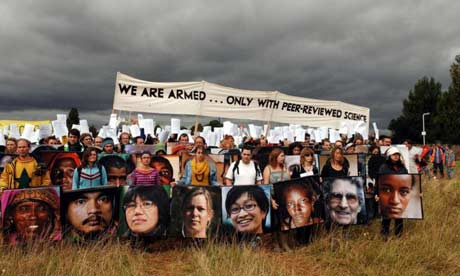
The Camp's great strength is that theory and practice share a space for a week. Having kicked off with marches and due to finish on Saturday with direct action, in the days between there are workshops galore – a hundred or more – covering the usual themes as well as not a few tailored to specialist tastes: "the world lawn tango championships," "five-finger direct action training," and – one cannot but wonder whether practice and theory were united here -- "safe sex for activists." That Arthur Scargill made an appearance was welcome, although it was disappointing to see that he has not yet got it. (In the USA at the outset of World War Two it was union leaders who, against bitter resistance from big business, championed the conversion of auto plants to make planes. In the war upon climate change, just think: the skills of power station engineers; solar, wave and wind; surely a no-brainer.) The high-point was a session (pictured above) at which George Monbiot spoke on the role of the state in mitigating climate chaos -- although it was marred when that organ itself, in the shape of riot police, threatened to enter the camp, prompting most of the 250-strong audience to exit theory in a headlong rush to practice.
A degree of division arose with regard to the appropriate tactics for countering the police, but it was a no-win situation. Agreement to allow the police onto site – with their batons and video cameras, their bullying, snooping, sniffing and otherwise canine ways – would have necessitated constant surveillance of the surveillers, a continuous and enervating tug-of-war. The other option, the one taken, was to concentrate forces at the gates, to keep them at bay. With this, the boys in blue-and-dayglow-yellow needed only to build up forces at one gate, deploy riot police to the fore, or engage in any minor feint, in order to panic and disrupt the Camp. Which of course they did. In afternoons, during workshops. At two a.m. -- waking all with a cacophony of sirens that sparked a mass exit from tents, followed by the thuds of sleepy running bodies tripping over guy ropes. And then again, after adrenaline levels had subsided and campers had returned to sleep, at the break of dawn.
The question is, why have Her Majesty's police force decided to subject a crew of campers to such astonishing levels of harassment? What tactics are involved, and at what level were they authorised?
On harassment and intimidation the litany is endless. We observed their tactics, aghast. They must've looked up and memorised every petty by-law they could find, in addition to compendia of recent legislation. (Thanks to the cop who dropped his copy of the 'Pocket Legislation Guide on Policing Protest,' which gives an overview of legislation that can be used to stifle any form of legitimate protest, we know a bit more about an organisation, the National Extremism Tactical Coordination Unit, that assisted them in this.) They terminated our shuttlebus service (for ferrying participants from rail station to campsite) and arrested the driver on the grounds that one copper, claiming to have witnessed a passenger give a driver a donation, deemed it to be an unlicensed taxi. They filmed everyone. There were interminable and repeated searches of anyone entering or exiting camp -- and these were not the usual cursory pat down. In my case (not an extreme one): in addition to searching all bags and pockets they were uncommonly interested in the linings of my trousers; and they dismantled my mobile phone and took the battery out ("in case there's a razor blade concealed inside"). From me they took nothing but others were less fortunate. The innumerable items confiscated included: plywood, wheelie bins, a track for wheelchair access, a puncture repair kit, carpet, a board game and part of a windmill. And, of course, childrens' crayons. (They're a graffiti hazard, don't you know?)
Arguably the most visible and unarguably the most audible police presence is the helicopter. Upon arrival, I asked the copper who was searching me – time for such conversations was not rationed -- why the chopper was in the air. "It's because an incident is going on. Don't worry, it costs a fortune to keep it up there, it'll only be sent up when there's something going on." In fact, it was airborne about one minute in every three; deafening, menacing, watching. Even at night it hovered above us, and would sometimes swoop low – perhaps in case its clatter at normal altitude hadn't yet woken a few of those below.
So we may return to the question: why apply these tactics? The resources involved, in terms of manpower, equipment and fuel, are colossal. In conversation with a senior police officer, I listened to his point of view. "Don't get us wrong: we know very well that 99% of the people in the camp are completely non-violent. It's the other 1% we're concerned about." A machete, he claimed, had been found in nearby undergrowth. During my days there, I saw nothing to suggest a potentially violent "1%" – and, unlike the officer, I was observing campers up close. The machete story is a smear. Chances are it is a fiction, or planted, or belonged to a nearby villager. Activists, being ecologically aware, know full well that to approach Kingsnorth does not require hacking paths through jungle. But let's assume for a moment that he is right. There are around 1,000 people at the Camp. If that same officer were responsible for policing a village of 1,000 people, and was informed that 10 were potentially violent, would he call up a fleet of fully-manned vans from the North Wales Heddlu, alongside similar convoys from the West Mids, South Yorks, the Met, Essex, Kent and all? Rumour has it that 27 forces were involved! Would he call in a helicopter, and riot police? Or would he think "me oh my what an English idyll – a pity, perhaps, about one or two delinquents at closing time on a Friday night, but a token presence should deal with that"?
Perhaps there is a better reason: the police tactic is all about defending Kingsnorth. After all, the Camp's clearly and openly stated aim is to shut it down. But this explanation has no more traction than does the "violent 1%." Participants show no sign of going anywhere near Kingsnorth until Saturday, so why police the Camp, which is situated many miles away, all week long? To the possible rejoinder that an absence of police attention would encourage activists to approach the power station sooner than declared, there is an obvious reply. With the same police numbers deployed to harass the Camp, the power station could be thrice encircled: it could be sealed off by land, sea, air and any other conceivable avenue of approach, and with enough spare policepower to boot (no pun intended) that the Heddlu and the Brummies could be sent back home. Just think of all the trouble and tension that could be spared, not to mention police overspend.
The only possible reason for this level of intimidation – apart, perhaps, from an interest in giving riot cops some live training -- is that the police force is hell bent on hounding and intimidating the movement against climate chaos. This does not represent a departure from recent trends in policing – as witnessed in London at the anti-Bush protest (with its use of agent provocateurs) and the 'Circle Line Party.' Yet it is an escalation.
The question that remains is: who authorised this strategy? Downing Street, one would suppose, but we should be told.